

Campus All-Optical Network (POL) Solution
Reconstructing Campus Networks with Optical Fiber, Empowering a New Era of Smart Education

Introduction
Driven by the digital wave, smart classrooms, online learning, and IoT applications have become the new norm in campus life. Traditional campus networks, based on copper-based LAN architectures, face numerous challenges such as bandwidth bottlenecks, complex cabling, difficult maintenance, and high upgrade costs. Fholink, leveraging leading all-optical network technology, introduces a new-generation Campus All-Optical Network Solution. By delivering fiber directly to rooms, it builds a future-proof, ultra-broadband information expressway for teaching, research, management, and daily life.
1. Challenges of Traditional Campus Networks
- Bandwidth Bottlenecks: Limited copper cable bandwidth struggles to support applications like 4K/8K interactive teaching, VR/AR training, and high-performance computing.
- Complex Architecture: Multiple weak current rooms are required within buildings, with numerous aggregation layer switches consuming significant space and power.
- Cumbersome Maintenance: Dispersed nodes, multiple failure points, messy cables, and difficult troubleshooting lead to high operational costs.
- Poor Flexibility: Business changes or classroom function adjustments require extensive re-cabling, long cycles, and cannot respond quickly to demands.
- Difficult Upgrades: Upgrading to higher bandwidth requires replacing all copper cables and equipment, resulting in significant investment waste.
2. Our Solution: All-Optical Reconstruction, One Fiber for Multiple Capabilities
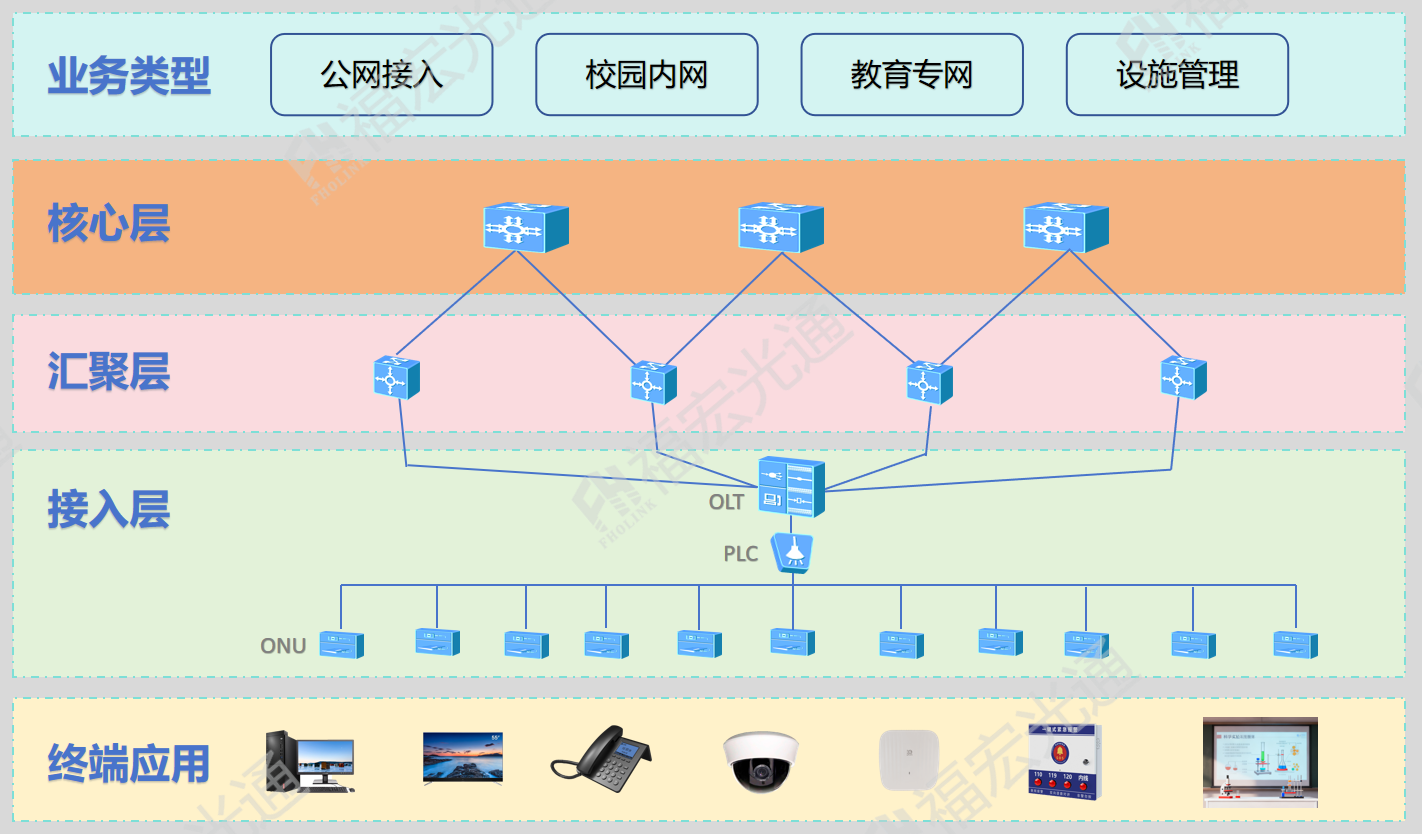
This solution adopts POL (Passive Optical Network) technology, replacing the traditional three-tier "core-aggregation-access" network structure with an ultra-simple architecture of "source node + passive splitter + fiber terminal."
2.1 Network Architecture: Simple, Green, Efficient
- Core Equipment Room: Deploys OLT (Optical Line Terminal) equipment as the network's brain, uniformly managing and controlling all optical network terminals across the campus.
- All-Optical Distribution Layer: Uses single-core fiber from the equipment room to all buildings and floors, split via passive splitters. Splitters require no power or maintenance, greatly simplifying in-building weak current facilities.
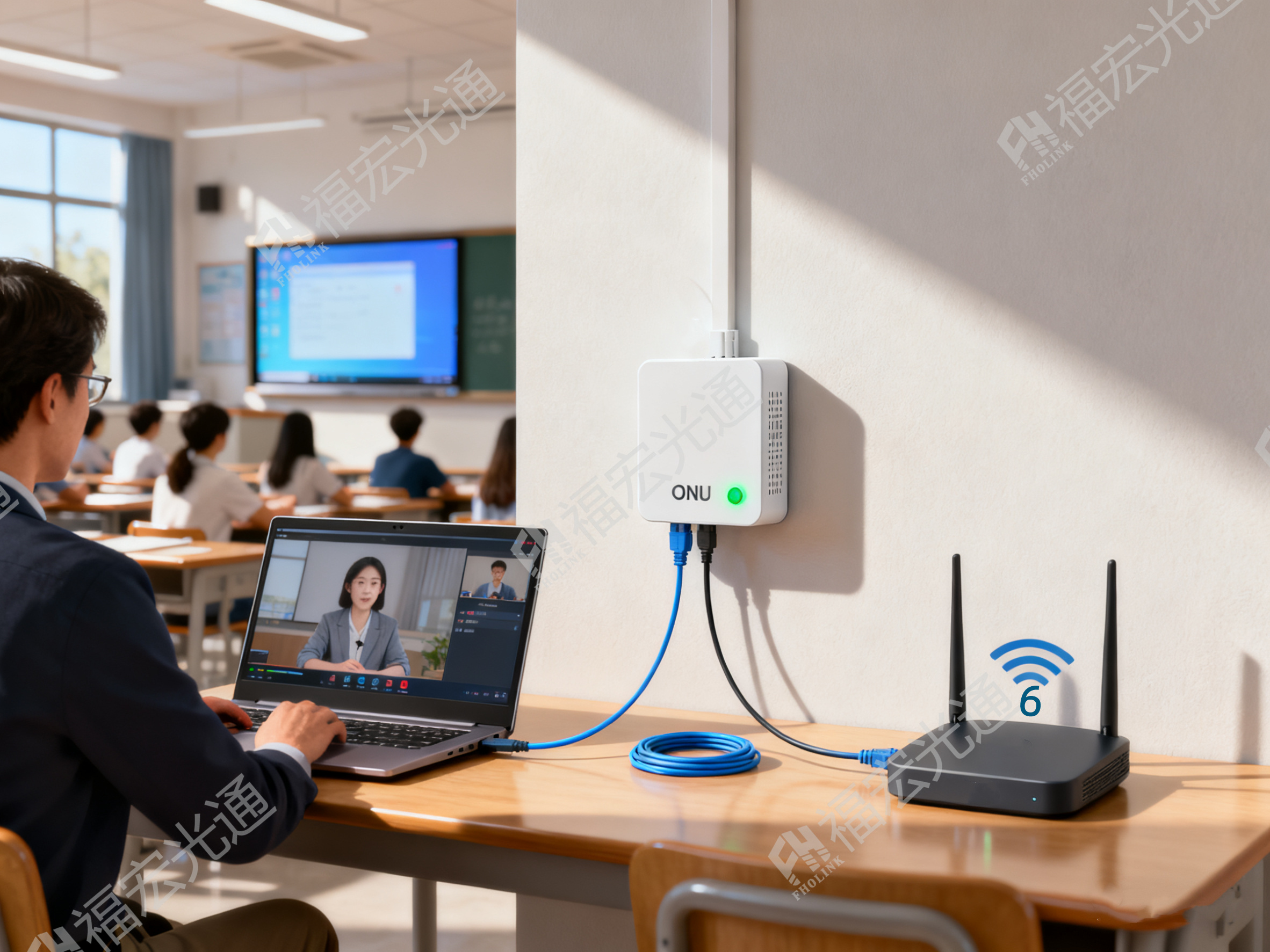
- Flexible Access Layer: Deploys compact ONU (Optical Network Unit) terminals in classrooms, offices, dormitories, laboratories, and other endpoints, providing high-speed optical and Ethernet ports to meet various terminal access needs.
2.2 Integrated Service Bearer: One Fiber Connects All, Everything Interconnected
A single all-optical network integrates all campus services, achieving "multiple networks in one":
- Smart Teaching Services: Provides ultra-low latency and high bandwidth for 4K remote interactive classrooms, electronic class signs, and cloud desktops.
- Campus Security Services: Offers stable, reliable dedicated channels for HD video surveillance and access control systems.
- Comprehensive Wireless Coverage: The all-optical architecture is the perfect partner for Wi-Fi 6/7, with ONUs directly providing high-speed backhaul for APs, enabling seamless roaming in high-density areas like dormitories and gymnasiums.
- IoT Services: Flexibly connects smart lighting, environmental monitoring, energy management, and other IoT terminals, supporting the construction of a green smart campus.
2.3 Intelligent O&M Management: Simplifying Complexity, Clear at a Glance
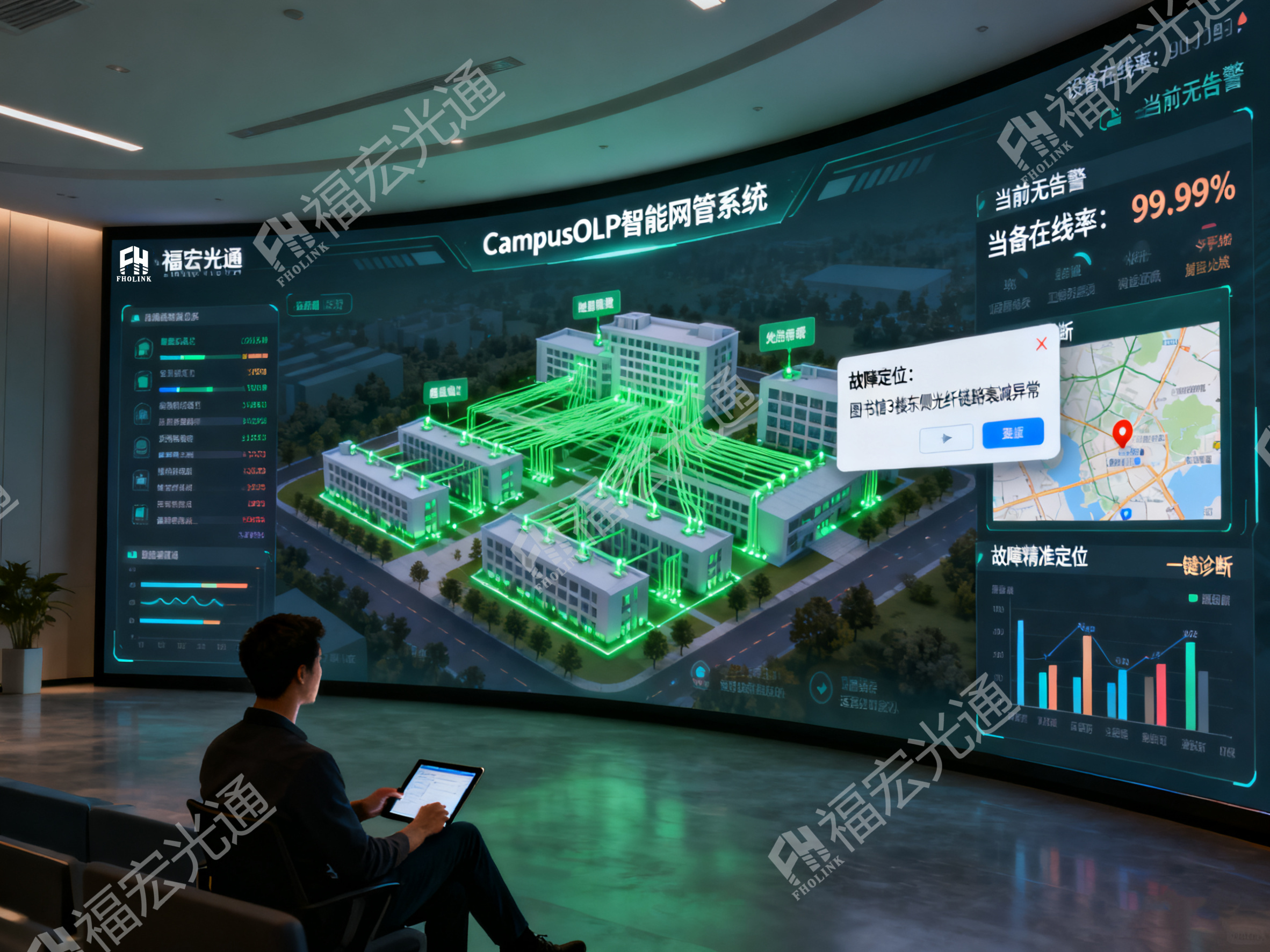
A unified CampusOLP intelligent network management platform enables centralized control of all OLT and ONU devices across the network.
- Topology Visualization: Automatically generates a full network topology map, clearly displaying device status and connection relationships.
- Precise Fault Localization: Combines optical link diagnostic technology to quickly locate fiber faults, significantly reducing troubleshooting time.
- One-Click Service Provisioning: Supports zero-touch configuration for newly installed ONUs, enabling plug-and-play and greatly improving operational efficiency.
2.4 Future-Proof Investment Protection
Currently deployed GPON or 10G GPON networks can be smoothly upgraded to 50G PON in the future by only replacing endpoint devices, without the need to re-lay fiber. One-time cabling delivers long-term benefits.
3. Core Value of the Solution
- Ultra-Simple Architecture: Passive splitters replace active aggregation, saving 90% of weak current room space and 60% of energy consumption, reducing TCO (Total Cost of Ownership).
- Ultra-High Bandwidth: Fiber optic bandwidth has unlimited potential, easily achieving Gigabit to desktops and 10 Gigabit to classrooms, meeting bandwidth needs for the next 10-20 years.
- Efficient O&M: Centralized management of the entire network, precise fault localization, and rapid service provisioning improve operational efficiency by over 50%.
- Security and Reliability: Passive networks are inherently immune to electromagnetic interference, and end-to-end encryption ensures data transmission security.
- Flexible Expansion: Adding new points only requires connecting fiber from the splitter, enabling rapid deployment and perfectly adapting to dynamic changes in campus services.
Conclusion
Fholink's Campus All-Optical Network Solution is not just an upgrade in network technology but a profound reshaping of smart campus infrastructure. We are committed to building a green, intelligent, and ultra-broadband new-generation campus network foundation for various educational institutions with simpler architecture, more efficient operations, and future-ready flexibility, helping educational informatization reach new heights.
Related Products
3. Integrated Gateway Equipment
4. GPON OLT (Optical Line Terminal) Equipment
5. GPON ONU (Optical Network Unit)
6. PLC Optical Splitters
7. GPON SFP Optical Modules


