

Smart River Monitoring
In river monitoring, optical communication plays a role far beyond being a data-transmitting "highway"; it itself serves as a highly precise, distributed "neural network" and "sensory system," capable of performing a "CT scan" on an entire river.
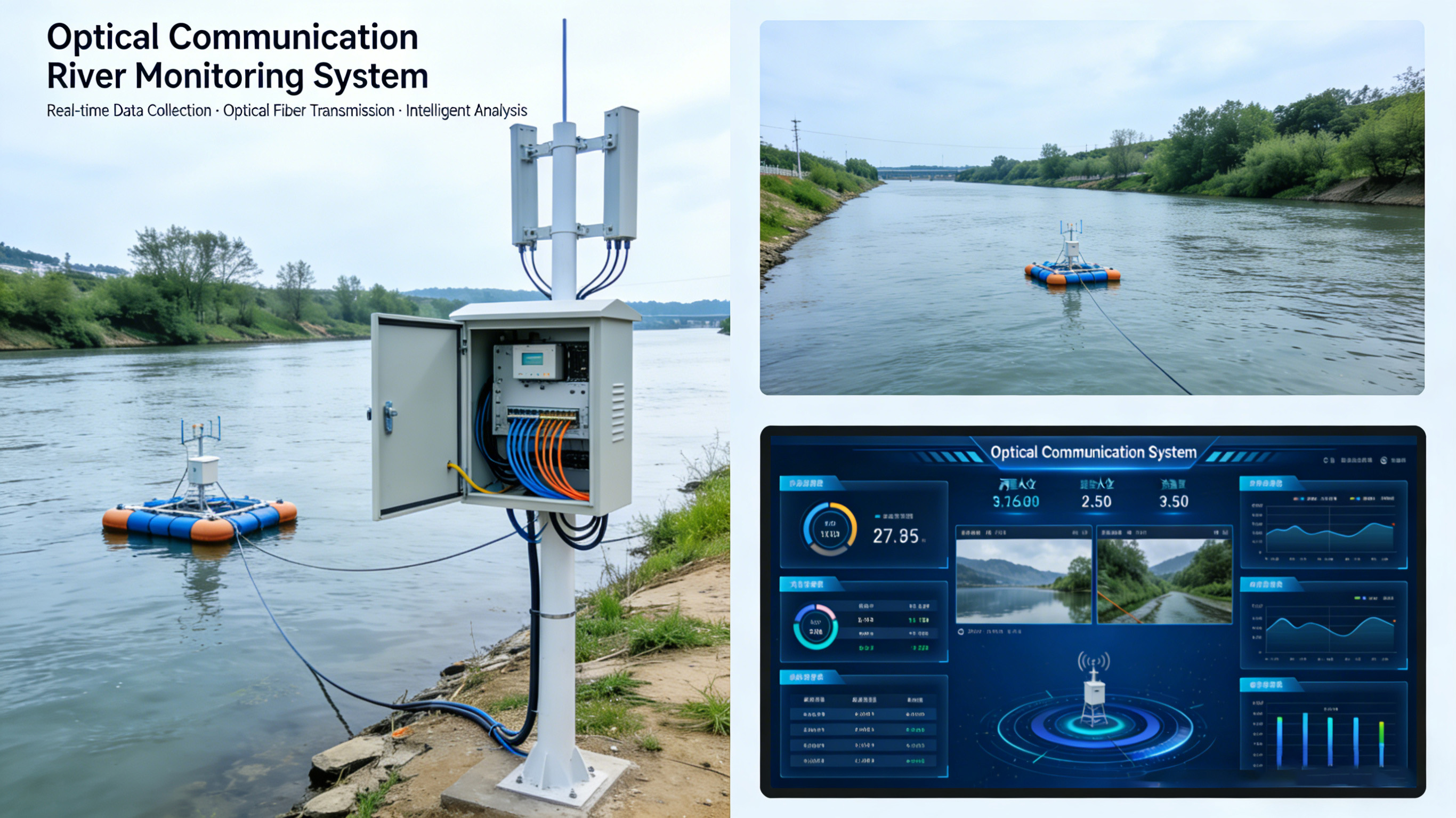
How Does Optical Communication "Sense" Rivers?
Traditional monitoring relies on cameras or point sensors, which can only see specific "points" or "surfaces." Optical communication technology, particularly Distributed Optical Fiber Sensing (DOFS) , transforms ordinary optical fiber into a "super sensor" stretching tens of kilometers, capable of perceiving changes in temperature, vibration, and strain along the entire fiber path in real time.
Four Core Application Scenarios
|
Application Scenario |
Monitoring Principle |
Key Technology |
Real-World Case / Data |
|
Riverbed Scour & Embankment Safety |
Fix optical fiber onto a "scour rod." As water flow scours, the rod's burial depth changes. Distributed Optical Fiber Vibration Sensing monitors the rod's dynamic strain to inversely calculate scour depth and velocity . |
AT-BOTDA (Adaptive Threshold Brillouin Optical Time Domain Analysis): Enables high-speed dynamic strain measurement with scour depth estimation error < 6%, while also monitoring water level changes . |
AT-BOTDA (Adaptive Threshold Brillouin Optical Time Domain Analysis): Enables high-speed dynamic strain measurement with scour depth estimation error < 6%, while also monitoring water level changes . |
|
Seepage, Piping & Internal Erosion |
Water seeping into an embankment mobilizes soil particles, generating micro-vibrations. Distributed Acoustic Sensing (DAS) can capture these vibration waveforms (single amplitude spike waveforms within 5-10 ms) for early warning . |
DAS (Distributed Acoustic Sensing) |
Japanese researchers have validated the feasibility of DAS technology for monitoring seepage and overflow failures in embankments through laboratory experiments . |
|
Hidden Sewage Outlet Detection & Water Quality Anomalies |
Underwater sewage discharge forms turbulence that generates vibration signals at specific frequencies. DAS technology can capture these signals, and through techniques like main frequency energy analysis, precisely locate sewage outlets (meter-level accuracy) and identify discharge periods . |
DAS + Signal Processing Algorithms |
A team from Nanjing University successfully validated this method's feasibility in simulated experiments on a river in Suzhou Industrial Park . |
|
Flow Velocity & Regime Monitoring |
Utilizes Fiber Bragg Gratings (FBG) to sense micro-strain caused by water flow impact. Different flow velocities correspond to different strains, enabling distributed flow velocity measurement . |
FBG (Fiber Bragg Grating) |
In laboratory flume tests, aluminum- and acrylate-coated fibers performed best and could be interrogated from dozens of kilometers away . A Nanjing University team, combining DAS with deep learning algorithms (DAS-Hydro HierarchyNet), achieved precise identification of complex flow regimes like "bubble flow" and "slug flow" in the Pearl River Delta Water Resources Allocation Project . |
Integration and Transmission Advantages: "One Fiber, Dual Use"
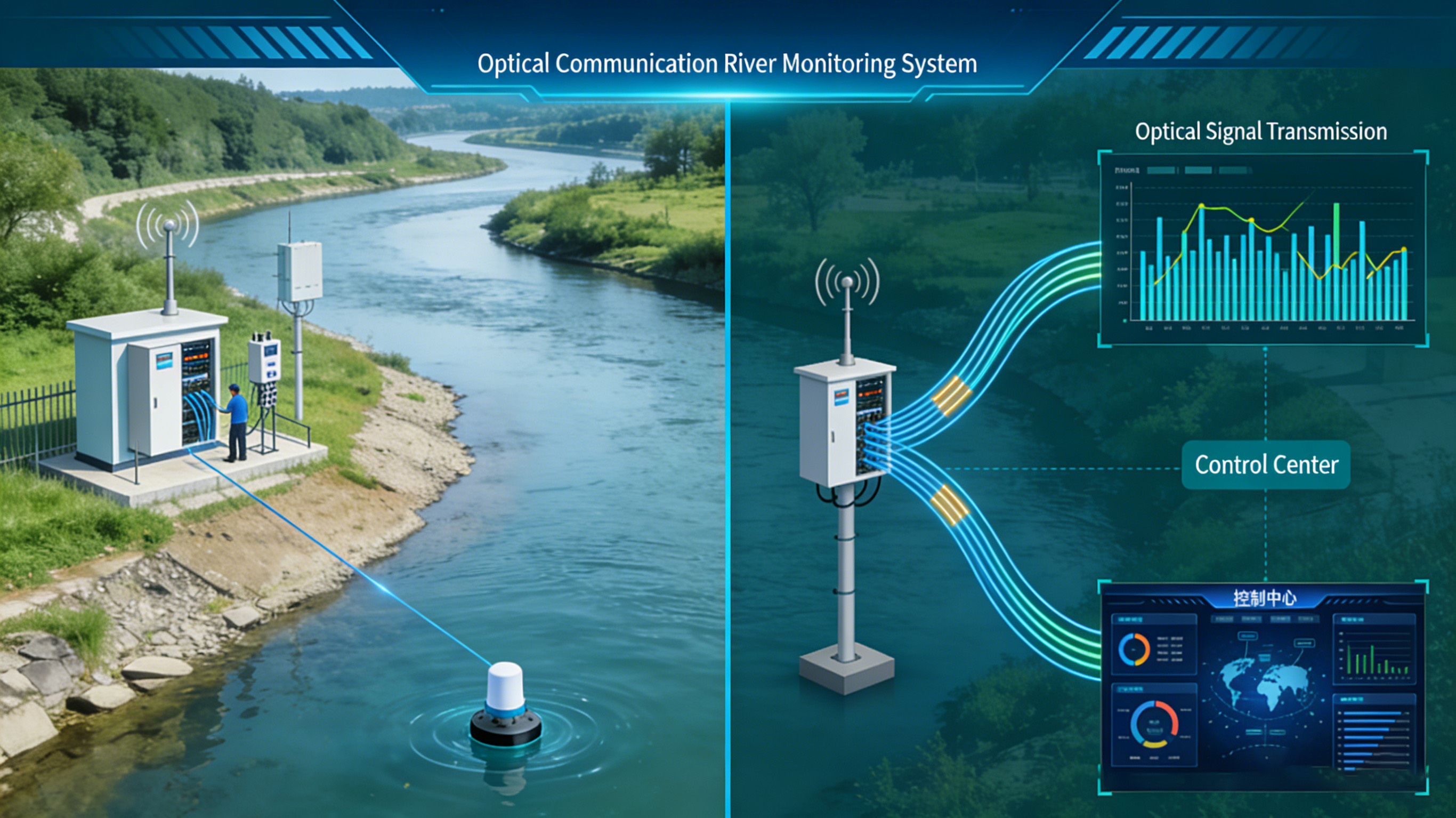
Besides acting as a sensor, the optical fiber itself is also the most reliable data transmission channel. An innovative practice by the Henan Hydrological Bureau of the Yellow River Conservancy Commission is quite representative. They successfully achieved "one fiber, dual use" for the dedicated fiber line of their disaster recovery center:
Technical Breakthrough: While ensuring the transmission of video-based flow measurement data, they multiplexed the same fiber as a backup channel for emergency flood reporting.
Practical Value: This means that during extreme weather or when the primary line fails, critical hydrological data can still be transmitted back via this "lifeline," greatly enhancing the reliability of hydrological monitoring and emergency response capabilities .
Conclusion
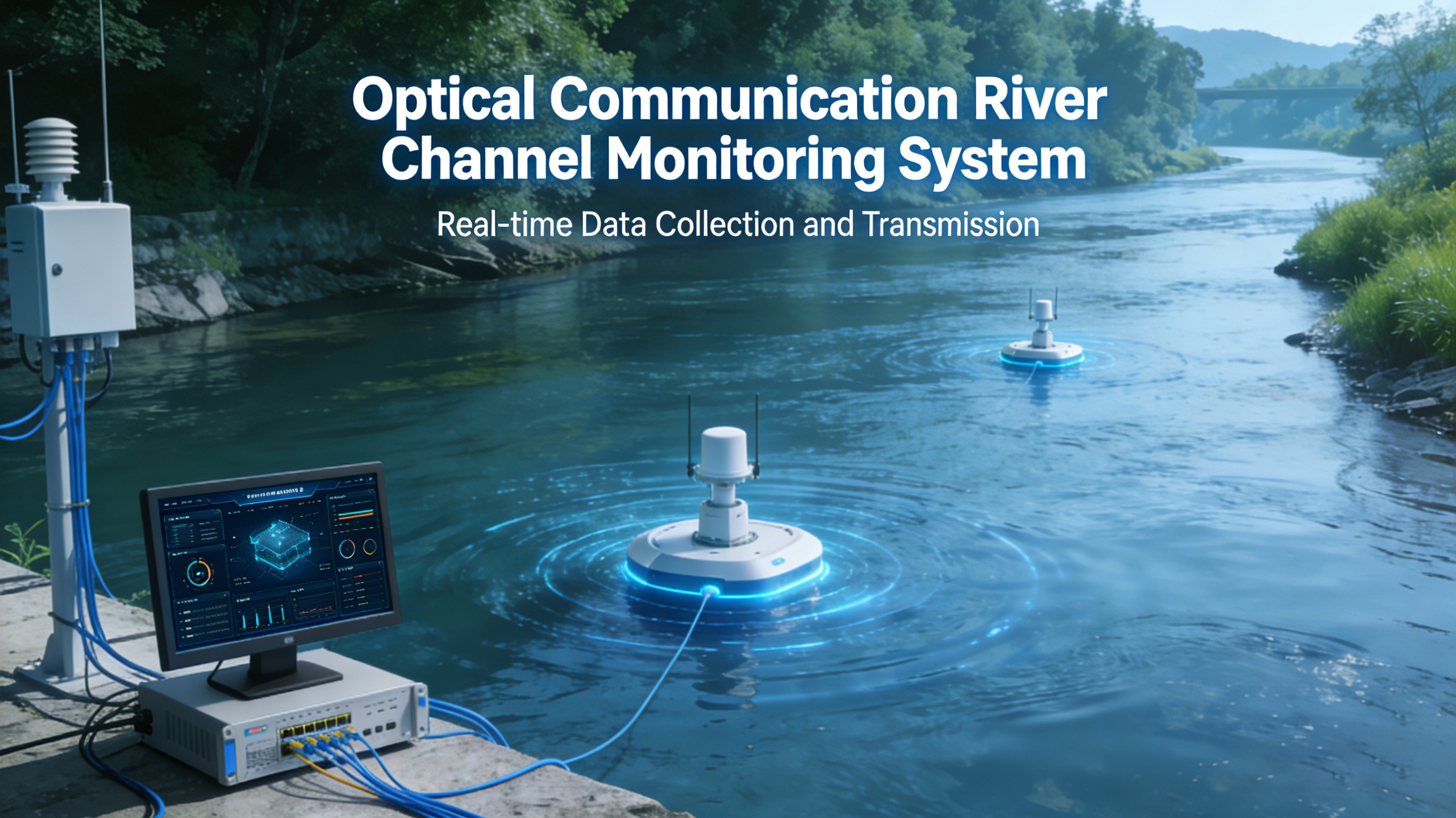
The application of optical communication in river monitoring has evolved from a simple "communication channel" to a comprehensive intelligent infrastructure integrating communication, sensing, and early warning. It allows rivers to "speak" and embankments to "feel pain," providing entirely new technological means for flood prevention and disaster reduction, water resource management, and ecological environmental protection.
Shenzhen Fholink Technology Co., Ltd. not only holds distinct advantages in traditional optical modules and wavelength division multiplexing (WDM) technologies but has also achieved breakthrough progress in distributed optical fiber sensing technology. Our company can configure corresponding solutions based on customer requirements. Both new and existing clients are welcome to contact us for consultation at any time!


