

Space Division Multiplexing (SDM) Technology
Space Division Multiplexing (SDM) is a key technology that breaks through the capacity bottleneck of fiber optic communication after Wavelength Division Multiplexing (WDM). By creating multiple parallel “spatial channels” within a single optical fiber, it multiplies communication capacity. The massive data generated by AI training and cloud computing is approaching the physical limits of existing fiber networks, making SDM a core path to shatter this “capacity ceiling.”
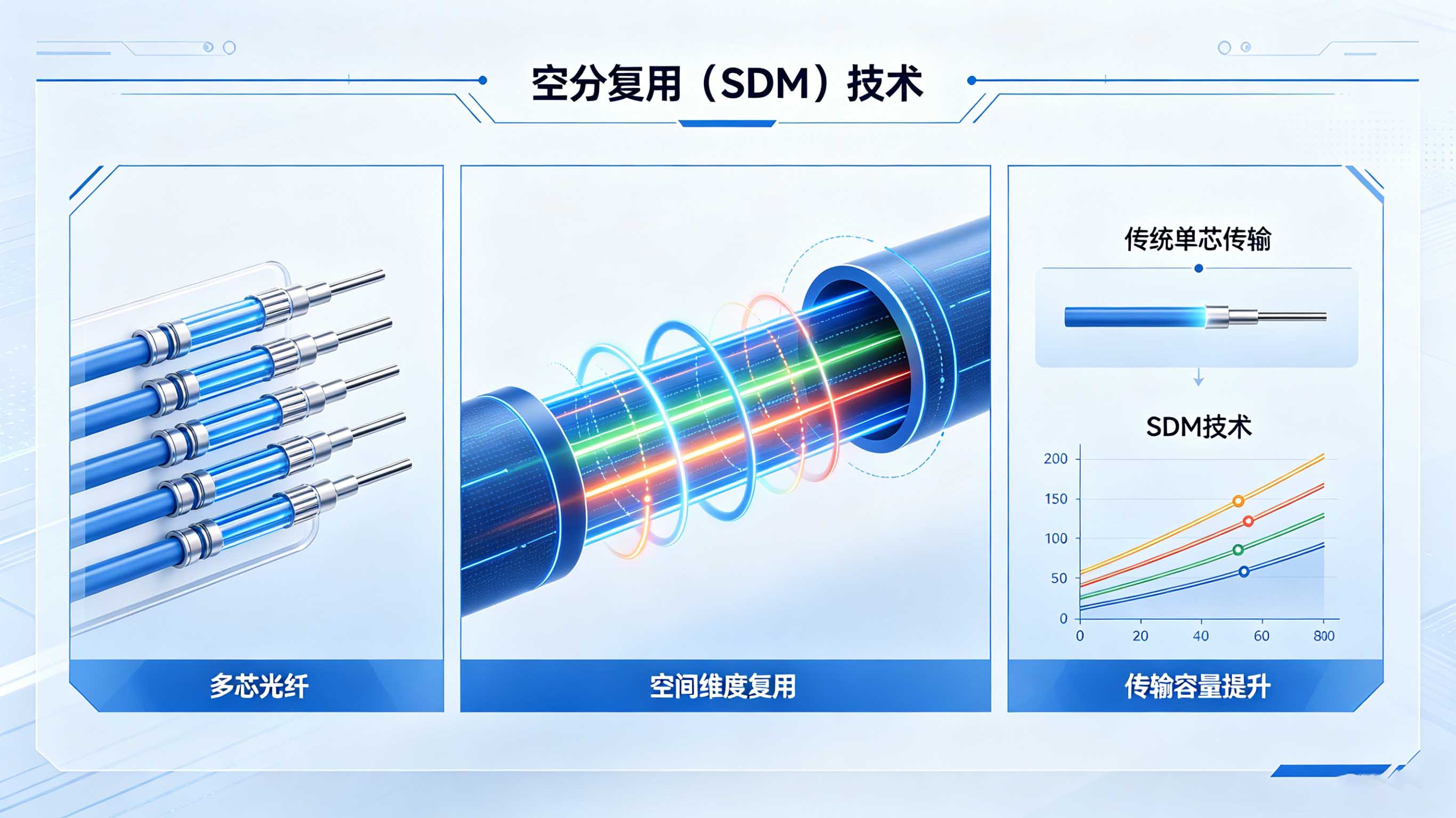
SDM technology mainly includes two core implementation methods:
Multi-Core Fiber (MCF)
- Core Principle: Multiple independent cores are arranged within the cladding of a single fiber, each acting as an independent transmission channel.
- Latest Achievements: Commercialization is progressing rapidly. The world’s first seven-core fiber submarine cable has been successfully laid, and an S+C+L three-band ultra-low-loss multi-core fiber optic line has been deployed, marking a new stage of commercial application for SDM technology.
- Capacity & Records: Theoretical capacity is significantly increased. A 19-core fiber has achieved a transmission capacity of 1.06 Pbit/s; in laboratory records, a 19-core fiber once reached an astonishing rate of 3.43 Pbit/s.
- Core Technologies: Fan-in/fan-out devices are used to connect multi-core fibers with standard equipment; femtosecond laser direct writing technology flexibly achieves inter-core optical coupling.
Mode Division Multiplexing (MDM)
- Core Principle: Within a single fiber core, multiple different light propagation modes (e.g., a small number of higher-order modes in Few-Mode Fiber, FMF) are used as independent channels for multiplexing.
- Latest Achievements: This is a major focus of academic research. Researchers have proposed using diffractive deep neural networks (D2NN) and fiber delay lines to map spatial mode information into the time domain, overcoming the bottlenecks of traditional architectures.
- Capacity & Records: Theoretical infinite expansion is achieved by exploring new physical dimensions. Orbital Angular Momentum (OAM) beams are a core technology.
- Core Technologies: In addition to traditional methods, high-speed all-optical neural networks can be used for signal processing to alleviate system complexity and power consumption issues. Hollow-core fiber (HCF) is also considered an ideal platform for OAM mode applications.
These two technological paths are not mutually exclusive; they are often combined to create hybrid structures such as multi-core, few-mode (MC-FM) fibers to maximize transmission capacity.
Key Supporting Technology: SDM Fiber Amplifiers
For large-scale deployment of SDM networks, SDM fiber amplifiers are indispensable supporting technologies, and research in this area has become a hot topic. They include Few-Mode EDFA (FM-EDFA), Multi-Core EDFA (MC-EDFA), and Multi-Core Few-Mode EDFA (MC-FM-EDFA) that combines the advantages of both. The core difficulty lies in simultaneously amplifying multiple spatial channels while ensuring consistent performance across all channels.
Challenges and Application Prospects
Despite its promising future, SDM technology still faces some engineering challenges before large-scale commercial application, including: inter-core/inter-mode crosstalk, high-precision fusion splicing technology, standardization processes, and high costs. At present, its clear application scenarios include transoceanic/marine communications (AI model training, autonomous driving, etc.), metropolitan area networks and Data Center Interconnect (DCI), as well as military and specialized fields.
This technology aims to build a solid next-generation communication network foundation to cope with the data deluge brought by AI large model training and autonomous driving, serving as a crucial infrastructure for the future information society.
Shenzhen Fholink Technology Co., Ltd. is keeping pace with the times. While continuing to strengthen its advantages in the traditional WDM field, the company has also made extensive strategic moves in Space Division Multiplexing (SDM) technology, forming strong alliances with multiple excellent industry partners and universities, achieving remarkable results. Both new and existing customers are welcome to contact us for consultation!


