

Fiber Optic Isolator
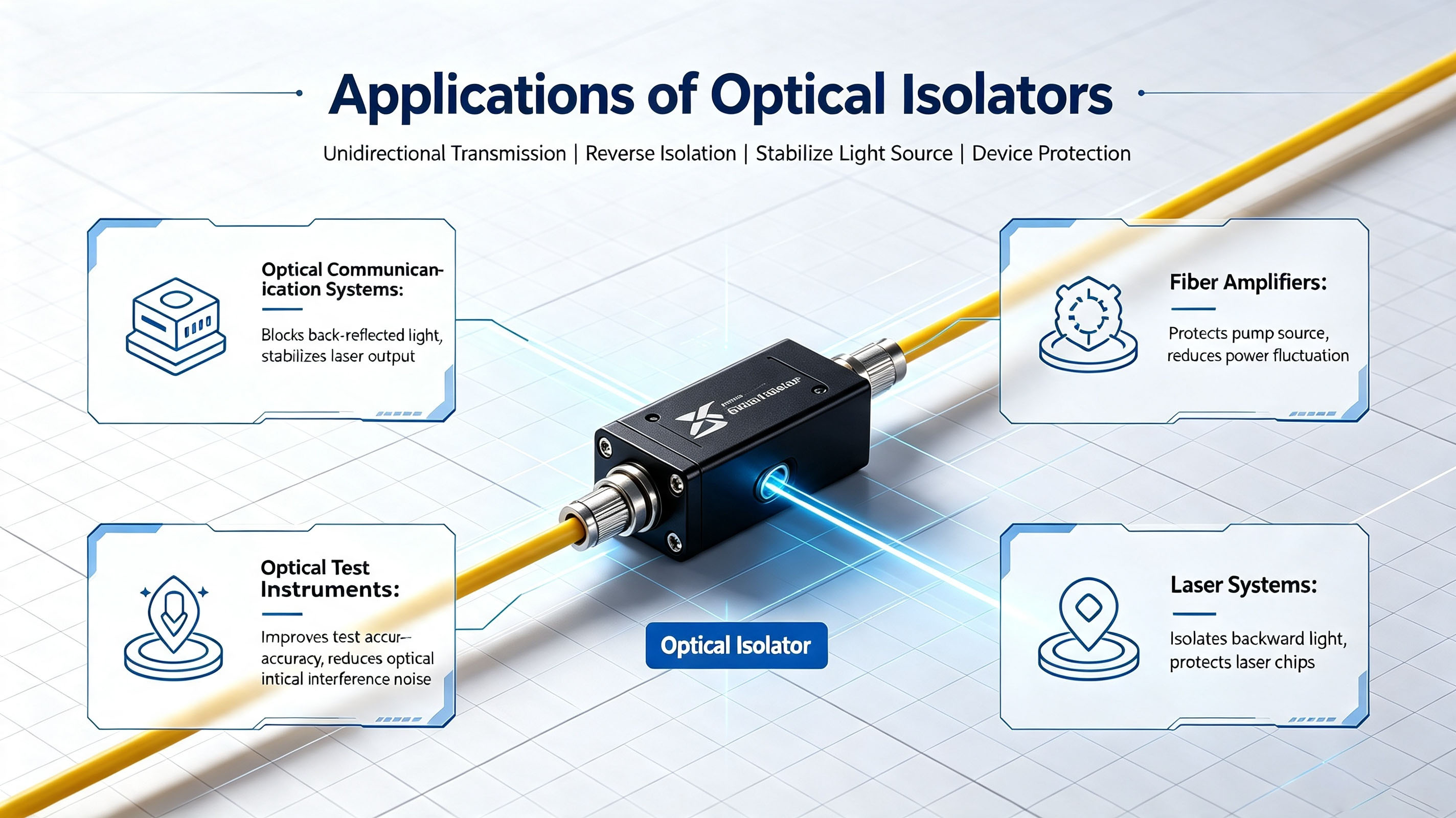
In an optical communication link, the fiber optic isolator is an unassuming yet critical "safety guard." It functions like a precision optical check valve, allowing optical signals to pass in the forward direction while strongly blocking any backward-propagating light. Its core mission is to protect the light source (especially expensive laser chips) and maintain system stability.
Why is it indispensable in optical links?
In fiber optic communication systems, reflections inevitably occur at fiber connector end faces, device interfaces, and other points. If this backward-propagating light returns to the laser, it can cause output power fluctuations, mode hopping, or even direct damage to the costly laser chip. In EDFA fiber amplifiers, reflected light can also trigger self-oscillation, rendering the entire system inoperable.
The core mission of the fiber optic isolator is to fundamentally solve this problem by establishing a "one-way barrier" between the light source and the transmission link, protecting the light source and maintaining system stability.
Operating Principle: The "Non-Reciprocity" of the Faraday Effect
The operating principle of a fiber optic isolator is based on the non-reciprocity of the Faraday magneto-optic effect.
Its basic structure consists of three parts: a polarizer, a Faraday rotator, and an analyzer. When linearly polarized light passes through a magneto-optic crystal placed in a magnetic field, its polarization plane rotates by a fixed angle (typically 45°). The key point is that this rotation is "non-reciprocal" – regardless of the direction in which light passes through the crystal, the polarization plane always rotates in the same direction.
Forward Direction: After two rotations, the polarization direction of the light aligns with the analyzer, allowing it to pass through smoothly.
Reverse Direction: The polarization direction rotates again in the same direction, ultimately becoming perpendicular (90° offset) to the polarizer, and is completely blocked.
It is this ingenious physical design that achieves unidirectional transmission.
Two Main Types
- Polarization-Dependent Isolator: Allows only light with a specific linear polarization direction to pass, suitable for polarization-maintaining fiber systems or sources with stable polarization states.
- Polarization-Independent Isolator: First splits the incident light into different polarization components, processes them separately, and then recombines them, ensuring low loss under any input polarization state. It is the mainstream choice for standard single-mode fiber communication systems.
Core Performance Parameters
The performance of a fiber optic isolator is evaluated based on the following key indicators:
- Insertion Loss (IL): The power loss in the forward transmission direction. Lower is better. Typical single-stage isolators can achieve values as low as 0.5 dB or less.
- Isolation (ISO): The attenuation of backward-propagating light. Higher is better. A single-stage isolator typically provides >40 dB, while dual-stage cascaded types can reach 55–60 dB.
- Return Loss (RL): The reflection of forward-propagating light within the device itself. Higher is better. High-quality products can achieve >60 dB.
- Polarization Dependent Loss (PDL): The variation of insertion loss with the polarization state of the input light. Lower is better. Typical values range from 0.1 to 0.2 dB.
- Operating Wavelength: Communication bands are primarily concentrated at 1310 nm and 1550 nm.
Wide Range of Applications
Fiber optic isolators have become ubiquitous in optical communication and laser technology:
- Fiber Optic Communication Systems: Protecting laser sources; a standard component in high-speed coherent communication systems and DWDM systems.
- Fiber Amplifiers (EDFA): Placed at the amplifier input and after the pump source to prevent self-oscillation.
- Fiber Lasers: Protecting seed sources and isolating reverse light between amplifier stages.
- High-Speed Optical Modules: A key component for protecting lasers in 400G/800G optical modules.
Fholink's Integrated Approach
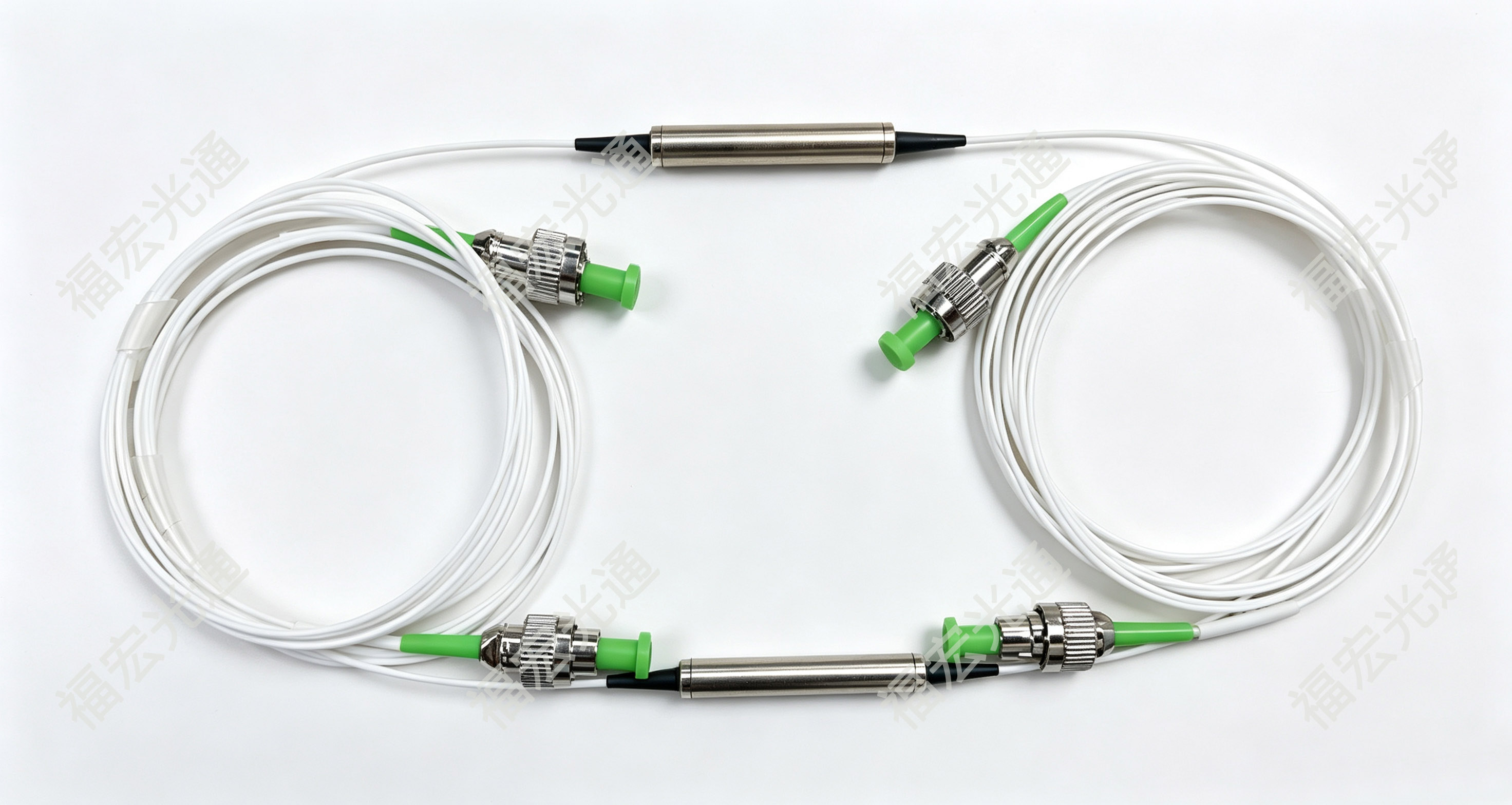
As a one-stop optical communication product provider, Fholink's value lies not only in offering high-quality fiber optic isolators as individual components but also in seamlessly integrating them into comprehensive solutions.
Solution Integration, Maximizing Effectiveness: In its high-speed IDC interconnection solutions, isolators work together with EDFA fiber amplifiers and WDM equipment to ensure the stability and reliability of high-speed transmission. In private networks with extremely high reliability requirements, such as those for water conservancy and military applications, isolators serve as foundational components for building hardware-level protection switching mechanisms (<50 ms), ensuring critical services remain "always online."
Significant Cost Advantage: Leveraging its own brand and complete product portfolio, Fholink offers various models and specifications of fiber optic isolators and other passive components, truly achieving "high quality at competitive prices."
Technological Evolution, Staying Ahead: With the explosion of AI computing power and the deployment of 800G/1.6T optical modules, optical isolators are evolving towards miniaturization, integration, and higher power handling. Fholink continues to invest in R&D, striving to incorporate cutting-edge technologies into its solutions and support customers' ongoing network evolution.
Summary
Although the fiber optic isolator may seem like an "unassuming" passive component, it plays an indispensable "guardian" role in optical communication links. Through these solid components, combined with its comprehensive solution capabilities and significant cost advantages, Shenzhen Fholink Technology Co., Ltd. is building stable, efficient, and reliable optical transmission foundations for IDC data centers, government and enterprise private networks, critical infrastructure, and other sectors.


