

What is an optical module?
I. What is an Optical Module? (Physical Definition)
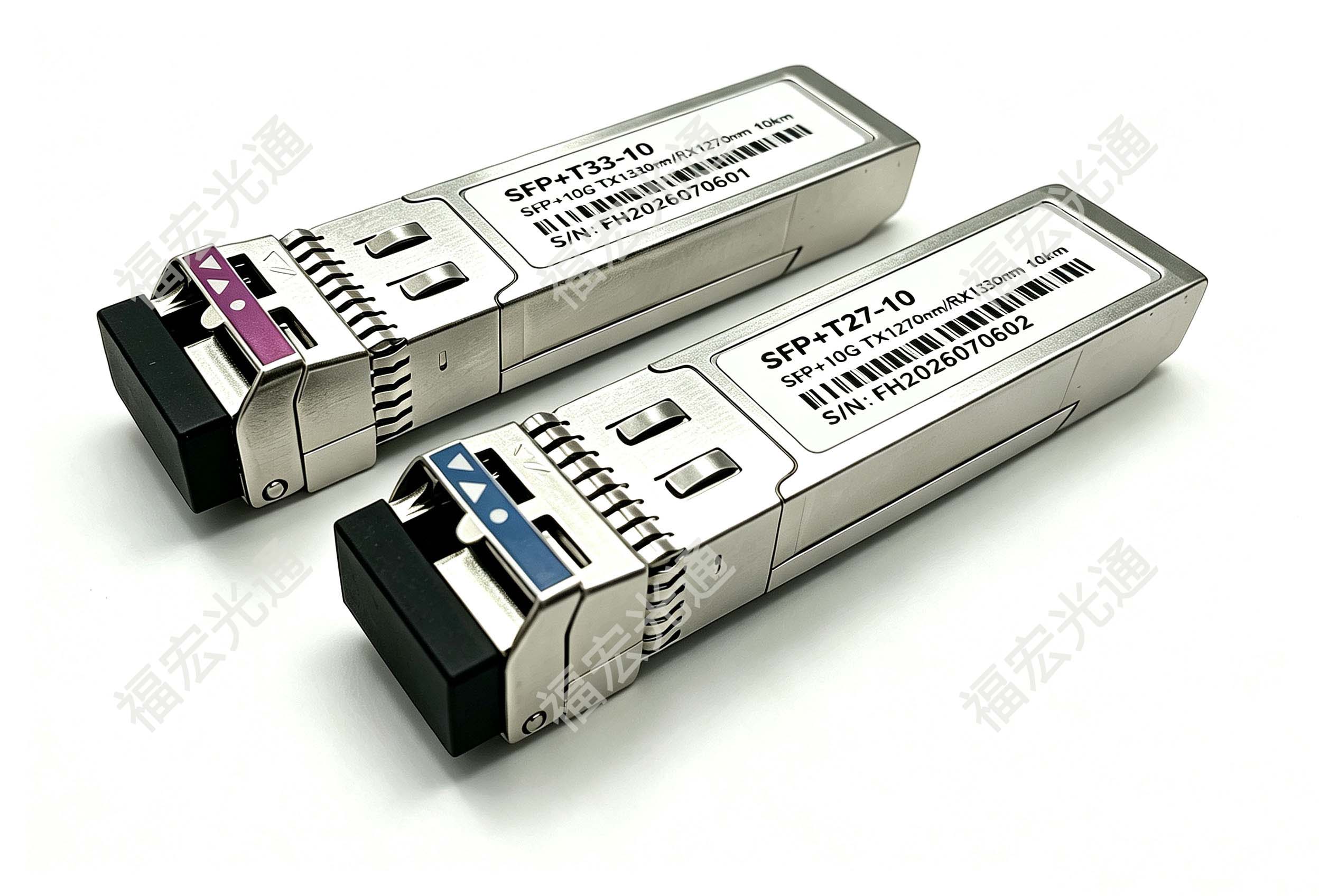
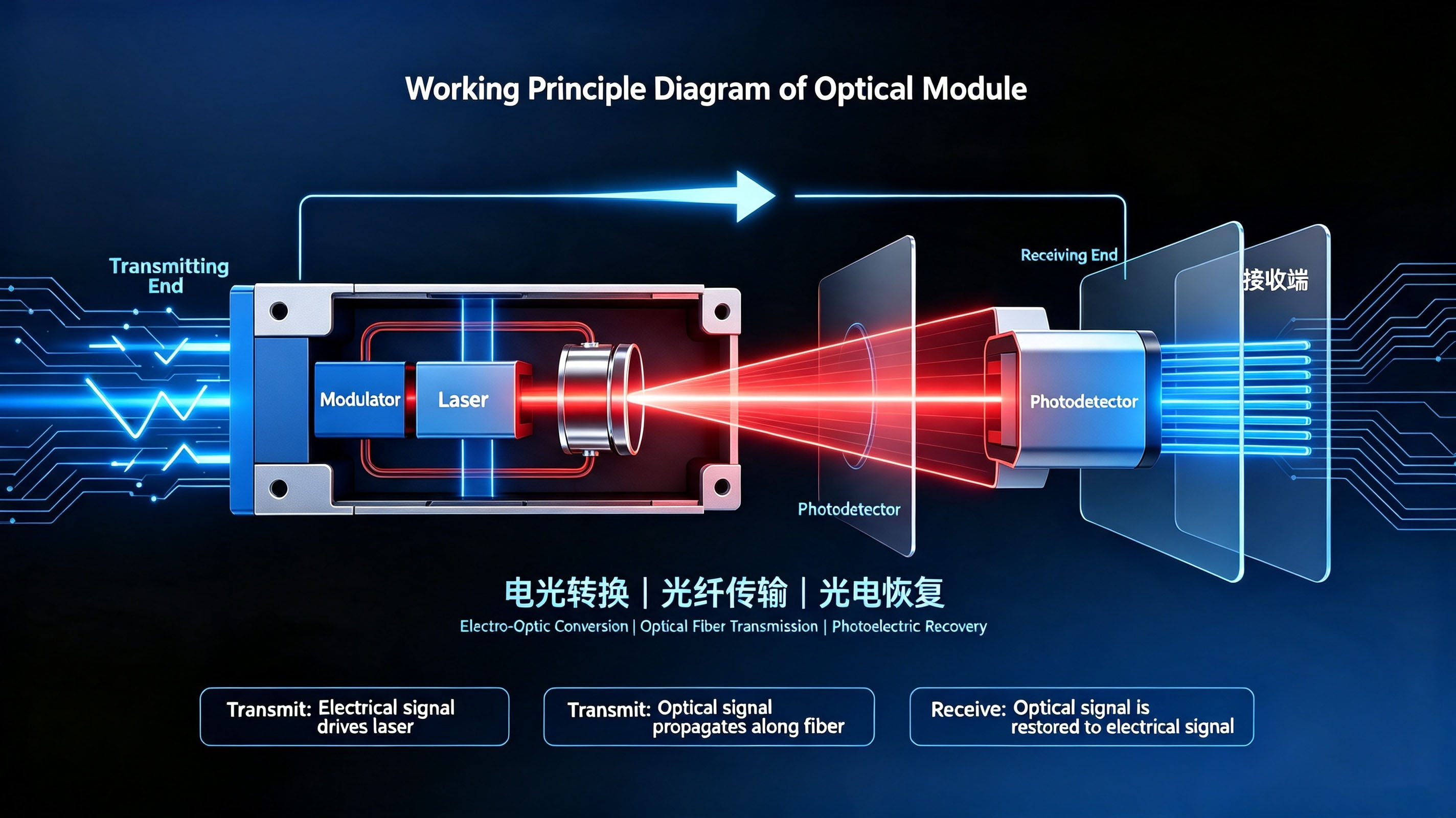
Colloquial Definition: An optical module is the "optical eye" and "electrical-to-optical translator" for network equipment (such as switches, servers, and routers). It is responsible for converting the electrical signals used internally by the device into optical signals for transmission, and simultaneously converting incoming optical signals from the fiber back into electrical signals for the device to process.
Physical Composition: It is a standard, hot-swappable component housed in a metal shell (common form factors include SFP, SFP+, QSFP, etc.). Despite its small size (some are as compact as a USB flash drive, others like a small bar of soap), it integrates four core components internally:
1. TOSA (Transmitter Optical Sub-Assembly): Contains a laser (VCSEL, DFB, or EML) and is responsible for the "electrical-to-optical" conversion.
2. ROSA (Receiver Optical Sub-Assembly): Contains a photodetector (PIN or APD) and is responsible for the "optical-to-electrical" conversion.
3. PCBA (Printed Circuit Board Assembly): Contains the laser driver chip and limiting amplifier, responsible for signal conditioning and Clock Data Recovery (CDR).
4. MCU (Microcontroller Unit): Responsible for Digital Diagnostic Monitoring (DDM), providing real-time reporting of temperature, voltage, bias current, and transmit/receive optical power (commonly referred to as "optical power telemetry").
II. What is an Optical Module Used For? (Core Value)
Its core mission is singular: to overcome the physical limitation that "high-speed electrical signals cannot travel far."
In electrical communications, high-speed signals above 10 Gbps propagating over standard copper cables (like Ethernet cables) for more than 10 meters suffer severe distortion due to high-frequency loss and electromagnetic interference (EMI). However, once converted to optical signals, they can travel tens or even hundreds of kilometers over optical fiber with losses as low as 0.2–0.35 dB/km, and are completely immune to lightning and electromagnetic interference.
In practical engineering applications, optical modules fulfill three primary roles:
1. Amplifier of Link Distance (Selection by Distance)
Short Reach (SR, Multi-mode): Uses multi-mode fiber (OM3/OM4) for distances of 100 to 300 meters, typically used for intra-rack interconnections within data centers (server to TOR switch).
Medium to Long Reach (LR/ER, Single-mode): Uses single-mode fiber (G.652) for distances of 10 to 40 kilometers, used in campus networks or metropolitan area aggregation layers.
Extended Reach (ZR/ZR+, Single-mode Coherent): Utilizes coherent DSP technology for distances of 80 to 120 kilometers and beyond, used for Data Center Interconnect (DCI) and backbone networks.
2. Multiplier of Fiber Utilization (Wavelength Division Multiplexing)
Grey Modules (Fixed Wavelength): One wavelength occupies one fiber, point-to-point.
Colored Modules (DWDM/CWDM): Support ITU-T standard wavelengths (e.g., C-band 1530 nm – 1565 nm). Using a multiplexer, dozens of optical modules operating at different wavelengths can be combined onto a single fiber. This transforms a single physical road into dozens of parallel lanes. Fholink's DWDM modules are our flagship products designed to resolve customers' fiber shortage challenges.
3. Flexible Plug-in for Network Architecture (Hot-Pluggable as a Service)
Optical modules adhere to MSA (Multi-Source Agreement) standards and support hot-swapping. This means network administrators can perform upgrades without powering down or interrupting services:
Upgrading speed (e.g., from 10G to 25G)
Adjusting distance (e.g., from 10km LR to 40km ER)
This modular approach is the foundation for the hardware resource pooling concept in modern Software-Defined Networking (SDN).
III. The "Three Checks" Principle for Optical Modules
In Fholink's delivery practice, we recommend selecting modules based on three essential criteria:
1. Check the Data Rate: 10G, 25G, 40G, 100G, 400G. The module's rate must match the switch port speed (downward compatibility is possible, but upward overclocking is not).
2. Check the Distance and Fiber Type:
Multi-mode (SR) must use aqua or beige multi-mode patch cords.
Single-mode (LR/ER) must use yellow single-mode patch cords.
Important: Always verify the link loss budget (Attenuation = Transmit Power – Receiver Sensitivity). A 3 dB engineering margin is typically recommended.
3. Check the Operating Temperature:
Commercial grade (0~70°C) for temperature-controlled data centers.
Industrial grade (-40~85°C) for outdoor pole-mounted cabinets or environments without air conditioning.
In summary:
Optical modules are the "cellular units" of optical communication networks. Without them, even the most powerful core switches cannot transmit data outside the data center. With them, the data torrent of the global internet can traverse oceans and continents in milliseconds. If you have specific speed and transmission distance requirements, I can recommend the exact optical module specifications you need and provide you with a corresponding price quote.


