

Component Crisis: The Supply Chain "Battle for Position" Ignited by AI Computing Power – How Fholink Is Breaking Through
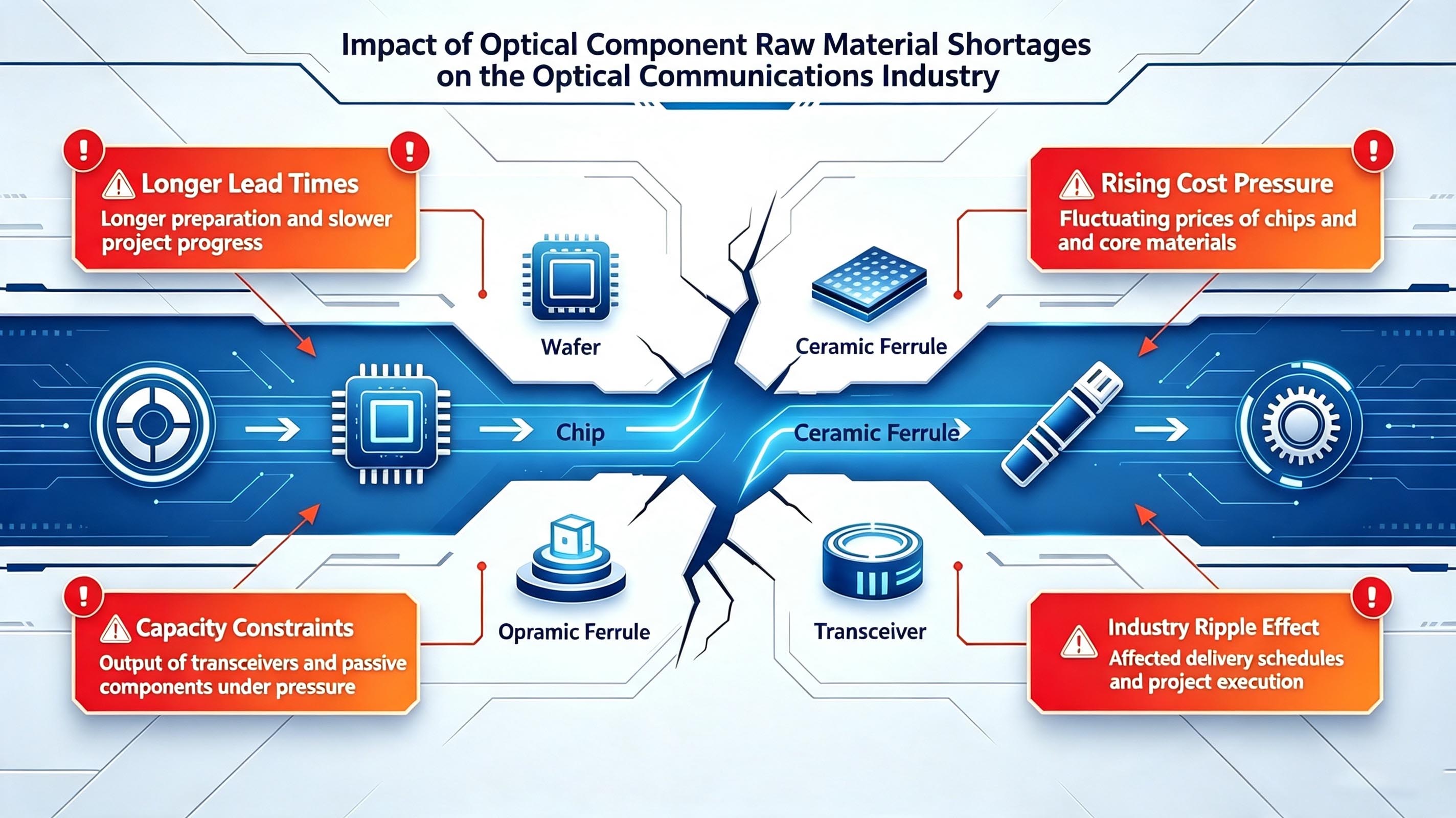
Since the second half of 2025, the optical communications industry has been hit by an unprecedented supply chain storm. From indium phosphide substrates to EML chips, from collimators and circulators to optical fiber preforms, upstream core materials are in critical shortage across the board. Orders are booked through 2027, prices have multiplied several times over, and lead times have stretched from 16 weeks to 40 weeks — these numbers reflect the severe turbulence the entire optical communications supply chain is currently enduring.
I. Root Causes: Demand Soars While Supply Hits the Ceiling
The fundamental driver of this shortage is AI computing power.
The demand for optical modules in AI data centers is "explosive" — a single AI server requires more than 10 times the number of optical modules compared to a standard server. In 2025, global shipments of 800G and above optical transceivers reached 24 million units, and are projected to soar to nearly 63 million units in 2026, a staggering 2.6‑fold increase.
Indium phosphide (InP) substrates — the irreplaceable core material for 800G/1.6T optical modules. A 2‑inch optical‑grade InP substrate, which cost $800 per wafer in early 2025, skyrocketed to $2,300–2,500 per wafer by April 2026 — a nearly 3‑fold increase, with spot prices for urgent orders even exceeding $3,000. In 2026, global InP demand reached 2.6 to 3.0 million wafers, while effective supply capacity stood at only approximately 750,000 wafers, leaving a supply‑demand gap exceeding 70%.
The shortage of optical chips is even more alarming. In 2026, global demand for 200G EML optical chips is estimated at around 150 million units, but deliverable effective supply is only 50 to 80 million units, creating a gap of 60%–70%. Leading manufacturers’ orders are already booked through the end of 2027 or even into 2028. The EML and CW laser chip shortage is expected to constrain market growth until the end of 2026.
Optical fiber preforms are also in critical shortage. Prices for the general‑purpose G.652D optical preform have risen by more than 180%; G.657.A2 preforms used for high‑density cabling in data centers have jumped from RMB 22–30 to RMB 160, an increase of nearly 550%. This tight supply is expected to persist through 2027.
II. Industry Impact: Cost Pressures Cascade from Components to Equipment
The upstream shortages and price hikes are propagating down the supply chain.
First, optical module costs are rising sharply. An EML chip costs approximately $8 per unit, accounting for 30% of the total module cost; the InP substrate price surge has already driven up EML chip prices by 10%–15% within the year, forcing module vendors to raise their own prices.
Second, equipment vendors are under delivery pressure. Optical modules account for a significant portion of optical transmission equipment costs. The price increases in upstream core components are already feeding into equipment quotations. The shortage of upstream devices is directly constraining the production capacity of high‑end optical transmission equipment.
Third, the industry is polarizing further. Leading players, having secured orders and built up inventories in advance, have so far seen limited impact on production and delivery. In contrast, numerous small and medium‑sized manufacturers, unable to secure essential materials, are operating at reduced capacity and face the risk of elimination.
This supply chain crisis reveals a harsh reality: competition in the optical communications industry has shifted from "production scale" to a broader contest of "supply chain resilience."
III. How Fholink Is Breaking Through
Strategy 1: Diversified Supply Chain Layout to Reduce Single‑Source Dependency
Against the backdrop of critical shortages across all core materials, Fholink has adopted a "multi‑pronged" supply chain strategy. The company has established long‑term partnerships with multiple upstream suppliers to avoid over‑reliance on any single source. By maintaining close communication with suppliers and securing production capacity in advance, Fholink ensures a stable supply of key materials. Locking in critical material capacity in advance is the most effective way to navigate supply chain tightness.
Strategy 2: Solution Integration Advantage to Reduce Dependency on Individual Components
Fholink's core competitive edge lies in its positioning as a "one‑stop solution provider." From EDFA optical amplifiers, OLP optical line protection equipment, and DCM dispersion compensation modules to a full range of optical modules and fiber optic patch cord consumables, the company covers nearly every aspect of an optical transmission network. This full‑stack capability brings a key benefit: when a particular component is in short supply, Fholink can optimize the system‑level design and replace it with combinations of other mature components to achieve equivalent functionality, thereby reducing reliance on any single scarce material.
Strategy 3: Flexible Cost Management and Pricing Adjustments
Faced with cost pressures from raw material price volatility, Fholink has built a systematic response framework — employing measures such as cost pass‑through, procurement management, technology substitution, and lean cost control to mitigate rising cost pressures. The company's product pricing takes into account multiple factors including market supply and demand, raw material cost fluctuations, technology upgrade cycles, and customer cooperation strategies, ensuring a balance between customer benefits and sound business operations.
Conclusion
The optical component shortages and raw material price hikes are an "unavoidable test" that the AI computing wave has posed to the optical communications industry. This supply chain crisis is both a challenge and an opportunity for industry consolidation and landscape reshaping.
Fholink's response has not been passive — it is striking proactively: securing supply through a diversified supply chain, reducing component dependency through solution integration, embracing change through technology iteration, and holding the bottom line through cost control.
Shenzhen Fholink Technology Co., Ltd. is proving through practical action that resilience shines brightest in the storm.


