

Polarization Beam Splitter / Combiner
In optical communication systems, the state of polarization is a physical quantity that is often overlooked yet critically important. When a beam of light propagates through an optical fiber, its polarization state randomly varies due to factors such as environmental temperature, stress, and bending — a phenomenon that poses numerous challenges to high‑speed coherent communications, fiber optic sensing, optical amplification, and other applications. The Polarization Beam Splitter (PBS) and Polarization Beam Combiner (PBC) are precisely the key passive components used in optical communication systems to "manage polarization" and achieve polarization control.
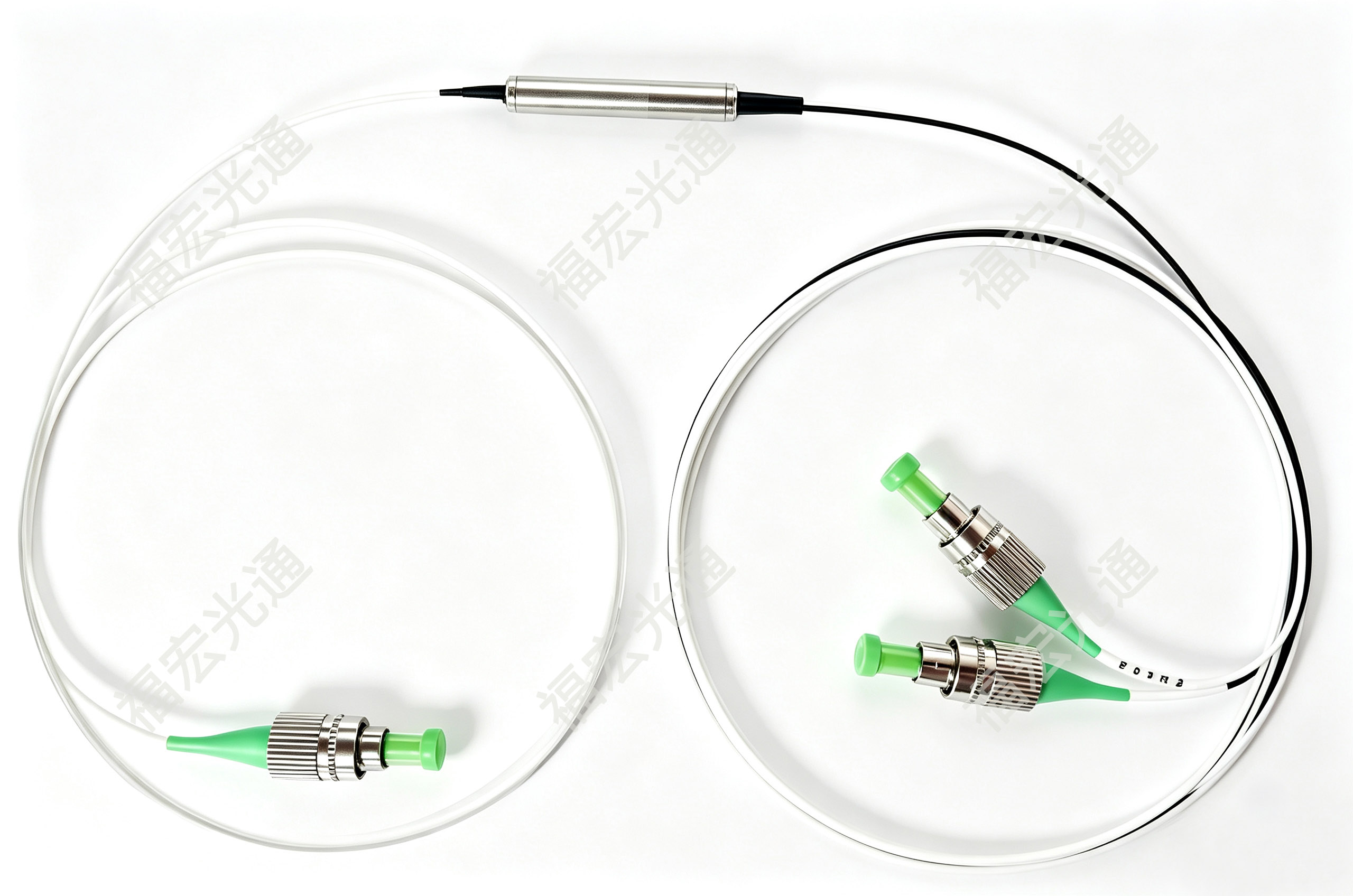
I. What are Polarization Beam Splitters / Combiners?
As the name implies, a Polarization Beam Splitter (PBS) is used to separate an incident beam containing different polarization states into two orthogonal linearly polarized beams according to their polarization directions. Conversely, a Polarization Beam Combiner (PBC) performs the opposite operation — combining two linearly polarized beams with mutually perpendicular polarization directions into a single beam.
In essence, PBS and PBC are the same device used in forward and reverse directions. When light enters from the common port, it acts as a beam splitter; when two orthogonal polarized beams enter from the two branch ports, it acts as a combiner. This "dual‑use" characteristic provides great flexibility in optical path design.
II. Operating Principle: Utilizing Birefringence and Polarization Selectivity
The operating principle of polarization beam splitters/combiners is based on birefringent crystals or polarization‑selective coatings.
In crystal‑based designs, the device exploits the property of birefringent materials — having different refractive indices for light of different polarization directions. The ordinary ray (o‑ray) and extraordinary ray (e‑ray) travel along different paths within the crystal, thereby achieving polarization separation or combination. Common designs include fused fiber couplers, polarization beam‑splitting prisms, and birefringent crystal plates.
In thin‑film‑based designs, the device employs a multi‑layer dielectric coating deposited on the hypotenuse of a prism. By utilizing the polarization selectivity when light is incident at a specific angle — P‑polarized light is transmitted while S‑polarized light is reflected — polarization splitting is achieved.
Regardless of the technical approach, the core objective remains highly consistent: to achieve high‑extinction‑ratio polarization separation or combination with the lowest possible insertion loss.
III. Key Performance Parameters
The performance of polarization beam splitters/combiners is evaluated primarily by the following core metrics:
|
Parameter |
Description |
Description |
Importance |
|
Insertion Loss (IL) |
Power loss through the device; lower is better |
≤ 0.6 dB |
Directly affects link budget |
|
Extinction Ratio (ER) |
Purity of the separated polarization; higher is better |
≥ 22 dB (min.) |
Core metric for polarization separation quality |
|
Return Loss (RL) |
Reflection of incident light by the device; higher is better |
≥ 50 dB |
Impacts system reflection noise |
|
Directivity |
Isolation of light from unintended ports |
≥ 50 dB |
Critical for crosstalk prevention |
|
Operating Wavelength |
Wavelength range supported by the device |
Multiple bands (780 nm – 1580 nm) |
Must match system operating band |
|
Power Handling |
Maximum optical power the device can withstand |
From milliwatts to watts |
Key selection criterion for high‑power applications |
> Note: Products with fiber optic connectors typically add approximately 0.3 dB of insertion loss, while return loss decreases by 5 dB and extinction ratio decreases by 2 dB.
IV. Two Main Types
Based on fiber type and application scenarios, polarization beam splitters/combiners are mainly classified into two categories:
- Polarization‑Maintaining Type (PM Type): Both input and output ports use polarization‑maintaining fiber, with the polarization direction aligned to the slow axis of the PM fiber. This type is used in applications with stringent polarization requirements, such as coherent optical communication systems and fiber optic sensing.
- Non‑Polarization‑Maintaining Type (Standard Single‑mode Type): Uses standard single‑mode fiber, suitable for applications with relatively relaxed polarization requirements, such as general optical power combining.
Additionally, based on port count, they can be divided into 1×2 (one input, two outputs) and 2×2 (two inputs, two outputs) types, with the latter supporting more flexible optical path configurations.
V. Wide Range of Application
Polarization beam splitters/combiners have permeated multiple core areas of optical communication and laser technology:
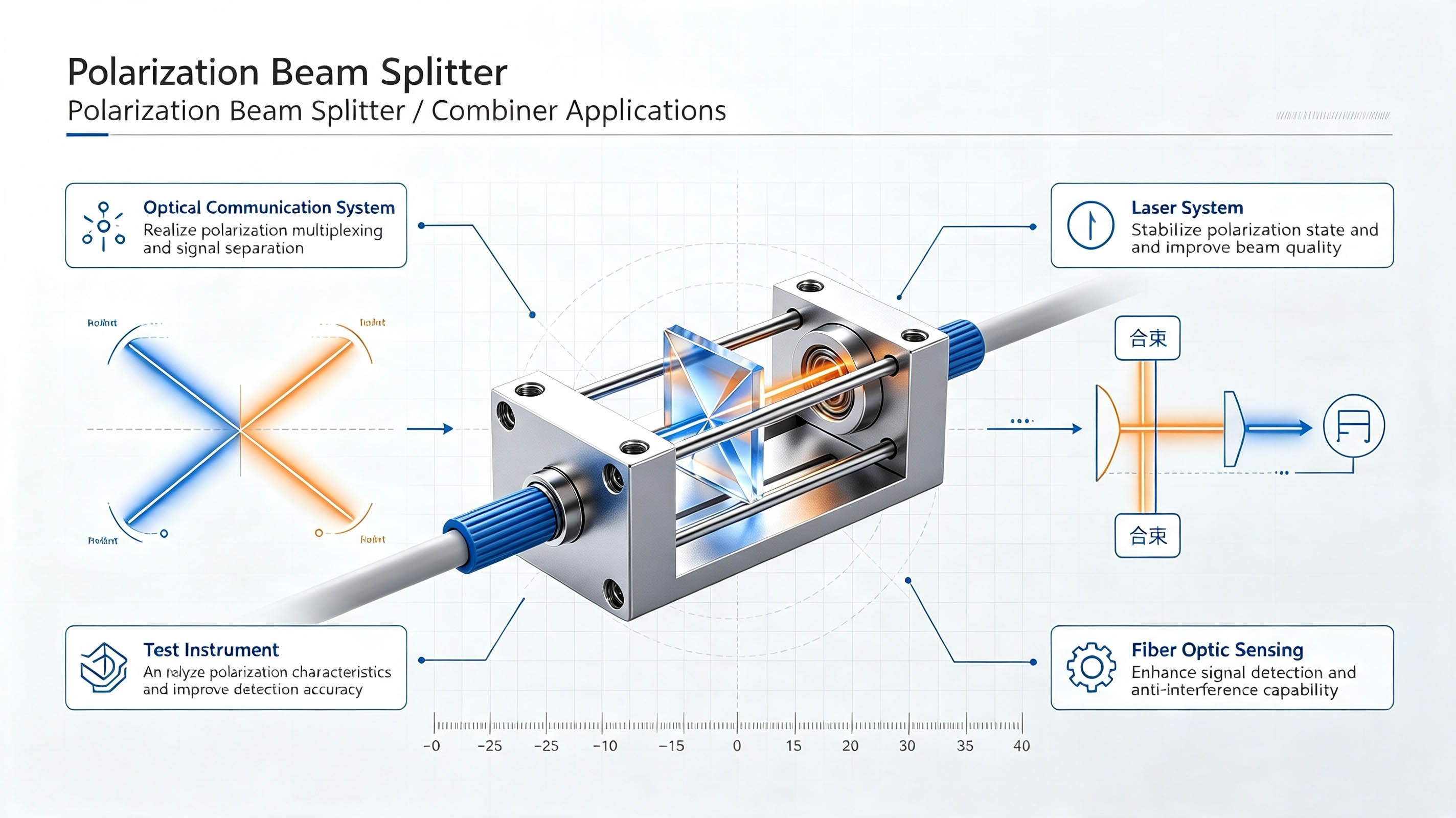
- EDFA and Raman Fiber Amplifiers: In Raman amplifiers, the gain depends on the polarization relationship between the signal and pump light. By combining two orthogonally polarized pump beams using a polarization combiner, the polarization dependence of the gain can be effectively mitigated, providing high pump power for Raman amplifiers.
- Coherent Optical Communication Systems: In coherent detection, polarization beam splitters are used at the receiver to separate the signal light into two orthogonal polarization components, which are then mixed with the local oscillator light. This is the core component for achieving Polarization Division Multiplexing (PDM) and demultiplexing.
- Fiber Optic Sensing Systems: Used for polarization state management and control in interferometric fiber sensors.
- Polarization Mode Dispersion (PMD) Compensation: Acts as a key component in PMD compensators.
- Pump Laser Power Combining: Combines multiple pump beams to increase the output power of fiber lasers.
VI. Fholink Technology: Integrating "Polarization Management" into Total Solutions
Although polarization beam splitters/combiners are "niche" passive components, they are often the critical factor determining system performance in high‑speed coherent communications, optical amplification, fiber sensing, and other applications.
Shenzhen Fholink Technology Co., Ltd. deeply understands the strategic value of these components. Within its comprehensive product portfolio covering EDFA optical amplifiers, DCM dispersion compensation modules, OLP optical line protection equipment, a full range of optical modules, and fiber optic patch cords, polarization beam splitters/combiners serve as foundational building blocks supporting high‑end applications such as coherent optical communications, Raman amplification, and polarization multiplexing.
Conclusion
Polarization beam splitters and combiners may not be as prominent as optical modules or optical amplifiers in the optical communications component family, but they are indispensable key components for "managing polarization" in optical communication systems. From pump combining in Raman amplifiers to polarization demultiplexing in coherent communications, and to polarization control in fiber optic sensing — these seemingly "invisible" devices underpin the stable operation of the entire optical communication system.


