

Polarization-Maintaining Optical Components
Light is a transverse wave, in which the vibration directions of the electric and magnetic fields are perpendicular to the direction of propagation. The state of polarization refers to the specific trajectory of the electric field vector in the plane perpendicular to the propagation direction, in terms of both direction and amplitude over time.
You can think of light as a "noodle" moving forward:
- Unpolarized light (Natural light): This "noodle" tumbles forward, with the electric field vibrating randomly in all directions, like a rolling rope with no fixed vibration direction.
- Linearly polarized light: This "noodle" is flattened into a thin sheet, vibrating up and down only in a single fixed plane, like a rope vibrating in a vertical plane.
The fundamental difference between polarization-maintaining optical components and ordinary optical components is that ordinary components are "indifferent" to the state of polarization, while polarization-maintaining components are dedicated to "locking in" and controlling the state of polarization.
It is analogous to ordinary fiber allowing light to travel on a "regular road," where the polarization state randomly fluctuates due to environmental disturbances, whereas polarization-maintaining fiber is like laying "rails" on the road, forcing the optical signal to maintain a fixed direction of travel.
Core Difference: From "Random" to "Locked"
|
Comparison Dimension |
Ordinary Optical Components |
Polarization-Maintaining Optical Components |
|
Core Function |
Focus only on optical power, wavelength, path, etc., without regard to polarization state |
Maintain and control the polarization state of the input light while performing standard functions (splitting, isolation, etc.) |
|
Operating Principle |
Based on symmetric structures; polarization state varies randomly due to environmental factors (temperature, stress) during transmission |
Utilize stress birefringence effects (e.g., Panda-type fiber) to create high-stress regions on both sides of the core, causing a significant difference in propagation constants between the two polarization axes, effectively "locking" the light onto a specific axis |
|
Applicable Scenarios |
General communications, ordinary data transmission, systems insensitive to polarization |
Coherent optical communications, fiber optic sensing, quantum communications, and other systems with stringent polarization requirements |
Process and Cost: Higher Barriers
The manufacturing of polarization-maintaining components is far more complex than that of ordinary optical components.
- Core Difficulty: Ordinary components focus only on conventional optical performance, whereas the challenge with PM components lies in ensuring precise alignment of the polarization axes (slow/fast axes) of the fiber. Any minor axis misalignment will cause a sharp degradation in the polarization extinction ratio.
- Process Threshold: It is widely recognized in the industry that 70% of PM component performance depends on the manufacturing process, while 30% comes from structural design. This requires more sophisticated equipment and more specialized technicians, making manufacturing significantly more difficult than that of ordinary components.
Applications: From "Optional" to "Essential"
The value of polarization-maintaining optical components lies in providing solutions for systems that require precise control of the polarization state. They are currently accelerating their penetration from traditional aerospace and military sensing applications into commercial markets such as AI computing power and data centers.
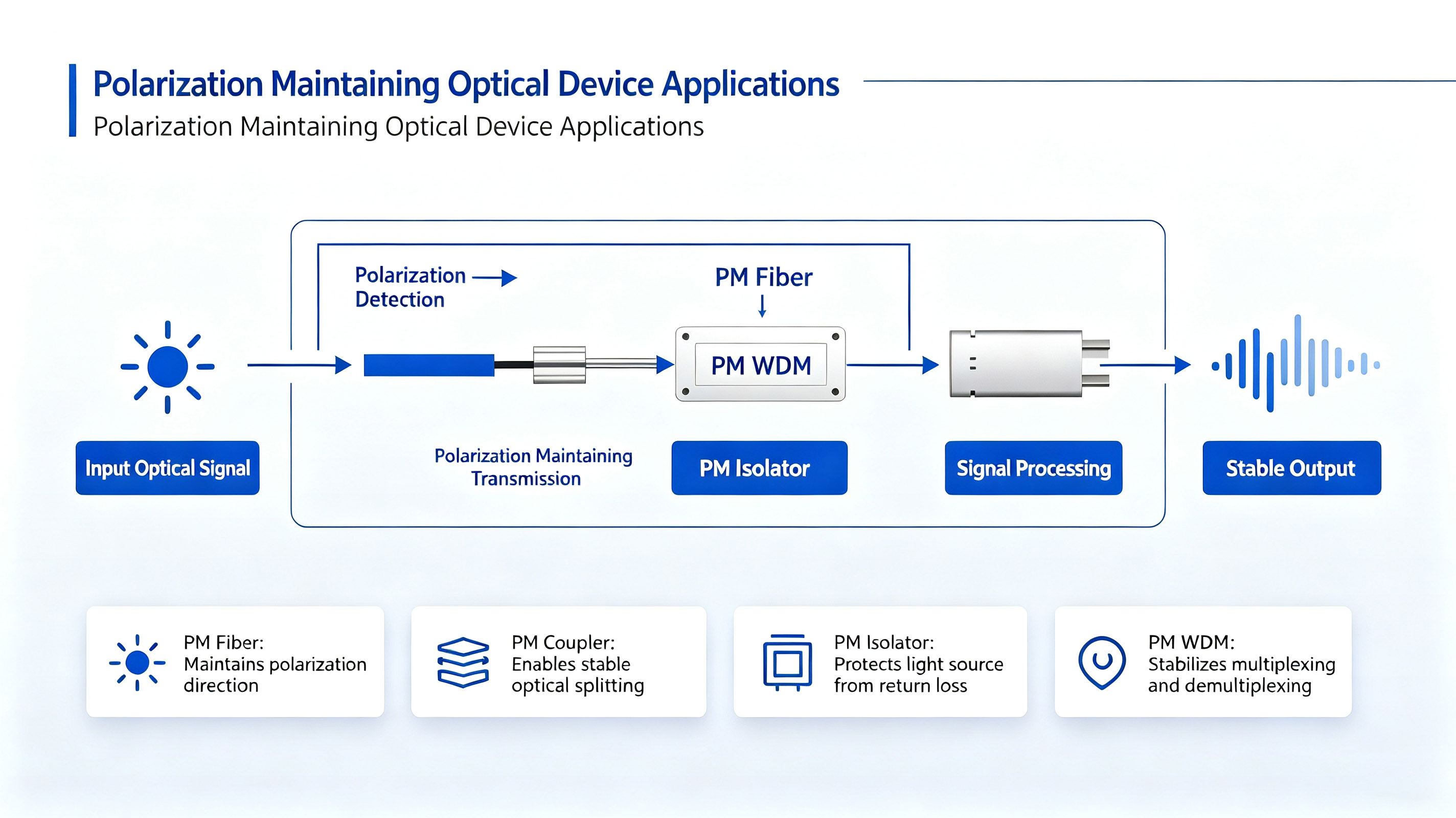
- Coherent Optical Communications: In 100G/400G/800G high-speed optical modules, PM components significantly reduce signal errors and ensure signal integrity over long-distance transmission.
- Fiber Optic Sensing: In precision sensors such as fiber optic gyroscopes and hydrophones, PM components provide stable optical signals, improving system sensitivity and accuracy.
- Frontier Technologies: In cutting-edge fields such as CPO switches, Quantum Key Distribution (QKD), and femtosecond lasers, PM components are indispensable key elements.
Conclusion
Choosing polarization-maintaining optical components essentially means trading higher costs and technical complexity for precise control over the state of polarization. In fields that demand ultimate performance—such as coherent optical communications, fiber optic sensing, and quantum technologies—PM components are critical to ensuring stable system operation.
Shenzhen Fholink Technology Co., Ltd. , with its comprehensive technology integration capabilities, offers more than just individual high-performance PM components—its strength lies in its positioning as a "total optical communication and transmission solutions provider." When customers need to build a complex PM optical transmission system (for example, in a specialized sensing or coherent communication project), Fholink can provide a one-stop portfolio of products and services—ranging from PM fiber, PM combiners, PM couplers, and PM circulators, to potentially integrated active modules. Visit the company homepage for more details.


