

Variable Optical Attenuator (VOA)
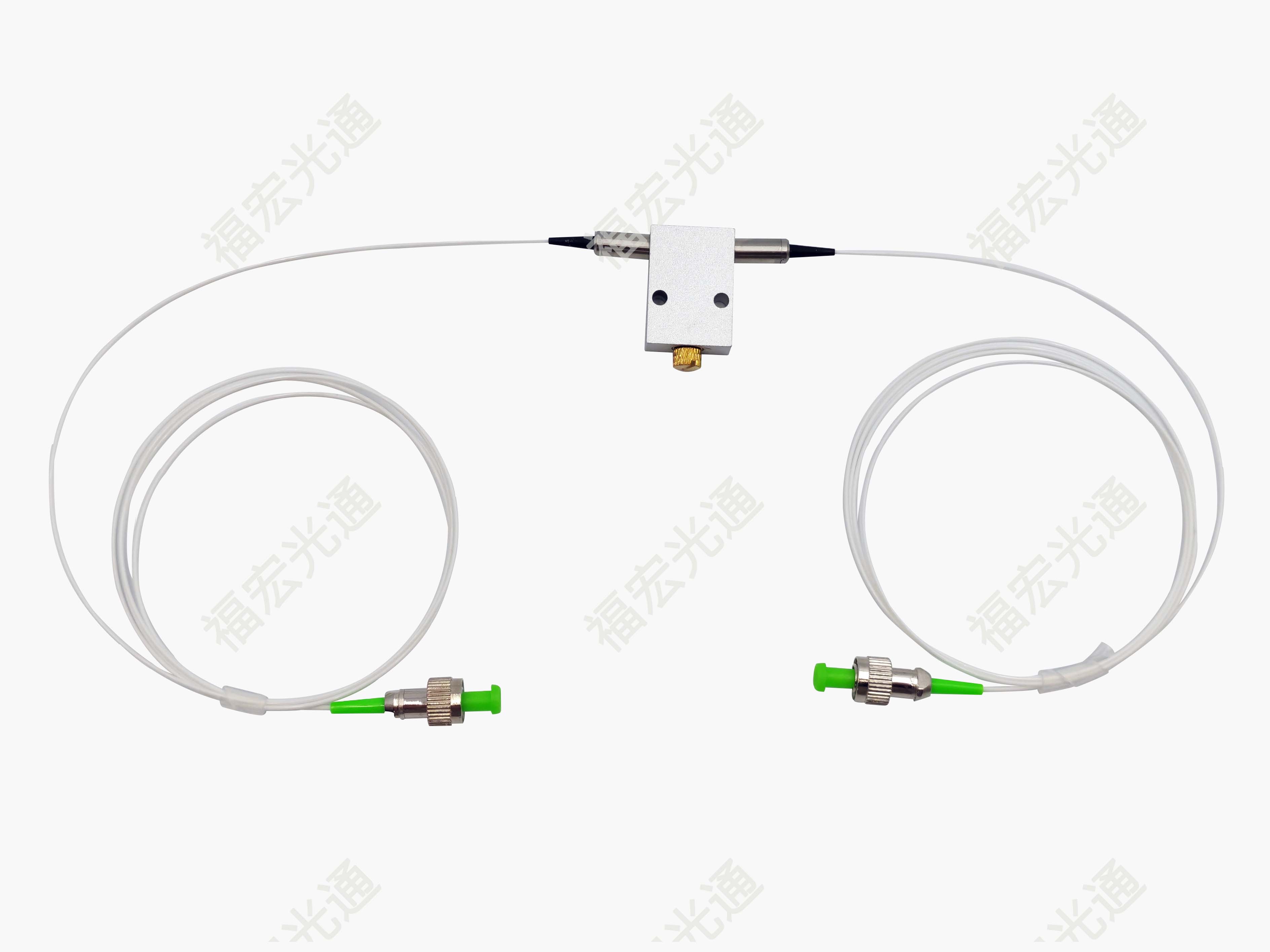
A Variable Optical Attenuator (VOA) is a passive optical device that can dynamically and precisely adjust the power of an optical signal passing through it according to an external control signal. It acts as an "optical valve" or "volume control knob" in the optical network, with its core task being to accurately attenuate the input optical power to a desired level.
Core Operating Principles
The implementation of optical power attenuation in a VOA essentially involves altering the physical state of the device through external drive (such as voltage or current), thereby changing the coupling efficiency of optical signals between fibers. Higher coupling efficiency results in lower attenuation; lower coupling efficiency results in higher attenuation. There are many technical approaches to achieve this, with the mainstream solutions primarily including the following:
|
Technology Type |
Core Principle |
Typical Implementation |
|
MVOA (Macro-Mechanical) |
Stepper motor/micrometer drives a light-blocking blade or misaligns a collimator. |
Precise optical power control achieved through physical displacement or angle change. |
|
MEMS VOA |
Electrostatic/thermal drive causes a micro-mirror (micron-scale) to twist or shift, changing reflection/coupling efficiency. |
An electrostatic force drives a micro-mirror to deflect. |
|
PLC (Planar Lightwave Circuit) |
On a planar lightwave circuit chip, the thermo-optic effect or electro-absorption effect is used to change the properties of the waveguide material. For example, heating changes the refractive index to create an optical path difference in the interferometer arms; or carrier injection increases the absorption coefficient of the waveguide layer to absorb the optical signal. |
Thermo-optic effect based on MZI (Mach-Zehnder Interferometer); carrier injection effect based on Electro-Absorption (EA). |
|
Liquid Crystal (LC) |
Utilizes the electrically controlled birefringence effect of liquid crystal materials. By changing the voltage applied to the liquid crystal layer, its effect on the polarization state or scattering characteristics of light can be controlled, thereby affecting the coupling efficiency of the subsequent optical path and achieving light intensity modulation. |
Electrically controlled birefringence; Polymer Dispersed Liquid Crystal (PDLC) light scattering effect. |
|
Magneto-Optic (MO) |
Utilizes the Faraday rotation effect. By changing the magnetic field, the polarization plane rotation angle of the optical signal is controlled, and then combined with an analyzer, the change in polarization angle is converted into a change in light intensity. |
Faraday rotator crystal. |
Key Performance Indicators
The performance of a VOA is mainly evaluated based on the following core parameters:
- Dynamic Range: The difference between the maximum achievable attenuation and the minimum insertion loss. Typically required to be greater than 20 dB; high-performance products can achieve 40 dB or even above 50 dB.
- Insertion Loss (IL): The fixed loss introduced by the device itself to the optical signal at the minimum attenuation state. The lower this value, the better.
- Polarization Dependent Loss (PDL): The difference in attenuation caused by different polarization states of the input light. The lower this value, the more stable the device performance.
- Response Time: The time from when the control signal is applied until the output optical power reaches stability. For systems requiring fast response, response time needs to be at the millisecond (ms) level.
- Wavelength Dependent Loss (WDL): The difference in device attenuation at different wavelengths, crucial for WDM systems.
- Return Loss (RL): The optical power reflected back from the input port. The higher this value, the less impact on the light source.
Main Application Scenarios
VOA is an indispensable component in modern optical networks and test systems, with its main uses including:
- Optical Power Equalization and Management: In WDM systems, performing power equalization for optical channels of different wavelengths to make the signal light energy uniform across channels; in optical amplifiers, achieving gain flattening and slope compensation.
- Optical Receiver Protection: Preventing excessively strong input optical power from causing distortion or even damage to the optical receiver.
- System Testing and Calibration: Used for precise control of input optical power in Bit Error Rate (BER) testing and receiver sensitivity testing of optical modules, simulating different channel conditions; also used for calibration and correction of optical instruments.
Summary
In summary, the Variable Optical Attenuator (VOA) is a device rich in technical content. It integrates multidisciplinary technologies including optics, micromechanics, and materials science. Its value lies in providing a dynamic, precise, and reliable power management tool for optical networks, making it one of the key foundational components for achieving flexible and intelligent optical networks.


