

CIOE 2026 — New Industry Technologies and Highlights
CIOE 2026 has almost become an "AI computing infrastructure exhibition." The entire industry chain is iterating technologies around the bandwidth and power consumption challenges brought by AI. The deep integration of AI and optoelectronics, as well as breakthroughs in domestic substitution of core technologies, are the two most central themes.
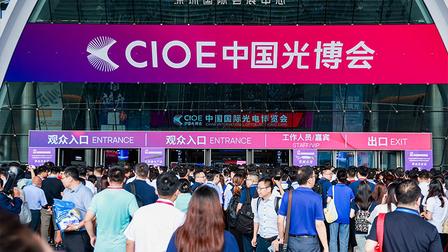
I. Optical Interconnect Technology: Leaping from 1.6T to 3.2T/6.4T
With the explosive demand for computing power from AI large models, the pace of optical module speed upgrades has accelerated markedly. 1.6T is gradually entering the stage of volume ramp-up, while higher-speed 3.2T and more advanced products have entered the sampling and customer validation stage.
1. Pluggable optical modules remain the current mainstay: Multiple vendors showcased 1.6T high-speed pluggable optical modules. For example, Cambridge Industries Group exhibited a 1.6T optical module based on OSFP packaging. Meanwhile, to further increase faceplate density, 12.8T XPO (pluggable co-packaged optics) became a new highlight. HGTECH Genuine showcased the world's first ultra-high-density pluggable liquid-cooled optical module, increasing bandwidth density by 4 times.
2. NPO/CPO accelerating industrialization: As key paths to reduce power consumption and improve integration, near-packaged optics (NPO) and co-packaged optics (CPO) were the focus of this exhibition. HGTECH Genuine dynamically demonstrated a 3.2T CPO optical engine for the first time, using a self-developed silicon photonics platform and micro-ring modulator chip, a core solution for next-generation supercomputing platforms. Guanglian Xinke showcased "Guangchi" GC1000, China's first micro-ring-based 3.2T NPO optical engine, and has smoothly evolved toward 6.4T.
Diversification of optical engine technology routes: Ruikang Guanglian has simultaneously laid out two technology routes, VCSEL-CPO and silicon photonics-CPO, to help customers hedge against uncertainty in technology routes.
II. Domestic Breakthroughs: From "Bottleneck" to "Building the Foundation"
In the fields of high-end optical chips, core equipment, and test instruments, the process of domestic substitution is accelerating.
1. Domestic substitution of high-end optical test instruments: Wanliyan Technology released a full-scenario optical testing solution and launched three self-developed instruments: a 110GHz vector network analyzer, a 1.6T network tester, and a 90GHz optical modulation analyzer. This solution covers the complete test chain from chips and modules to networks, aiming to strengthen the domestic testing foundation for high-speed optical interconnection.
2. Manufacturing equipment breaks through mass-production yield bottleneck: Guanglian Xinke globally premiered the "Zhiwei" ZW1000 silicon photonics maskless programmable lithography machine. This equipment can perform picometer-level wavelength trimming of micro-ring modulators on 12-inch wafers, raising micro-ring manufacturing yield from "passive screening" to 99%, laying the foundation for large-scale mass production of 3.2T/6.4T optical engines.
3. Progress in core optical chips: Guanglian Xinke also launched China's first 8-inch GaAs quantum dot wafer, as well as quantum dot DFB lasers and mode-locked optical frequency comb lasers based on this material, aiming to overcome the shortcomings in core components for domestic high-end optical communication light sources. Ruikang Guanglian's 50G VCSEL has achieved large-scale mass production, and its single-wavelength 100G PAM4 VCSEL has completed tape-out validation.
III. Fiber Technology Innovation: Paving the Way for Hollow-Core Fiber and Polarization-Maintaining Fiber
As a basic material, optical fiber is also innovating for AI and next-generation optical interconnection.
1. Hollow-core fiber moving toward commercialization: The anti-resonant hollow-core fiber showcased by YOFC became a focus, with a minimum attenuation of 0.04 dB/km, a single continuous length exceeding 91 km, and cumulative commercial delivery of over 10,000 core-kilometers.
2. Explosive demand for polarization-maintaining fiber: The extensive adoption of CPO/NPO solutions has brought polarization-maintaining fiber from specialized fields into the core of computing infrastructure. YOFC showcased a Prime series matching solution of polarization-maintaining fiber and single-mode fiber developed specifically for CPO/NPO optical engine FAUs (fiber array units), to address the challenges of polarization stability and efficient coupling in light source links.
IV. Consumer Optics: Ultimate Lightweighting for AR/VR
In the AR/VR field, Goertek Optics showcased an ultimate lightweighting solution for consumer-grade glasses.
1. Ultra-thin and lightweight optical waveguide: Its fully laminated etched full-color diffractive optical waveguide F20Ge-FL, by eliminating the air gap between lenses, controls the total thickness of the lens including the cover plate to 0.65 mm, weighs only 4 g, and achieves a transmittance of over 94% in the grating area.
2. Large field of view and high performance: Another F25Ge_DUV module adopts a DUV lithography etching process, and its MTF (image detail reproduction metric) is 30% higher than nanoimprint solutions, aiming to provide clearer display effects with stronger outdoor visibility.
Summary
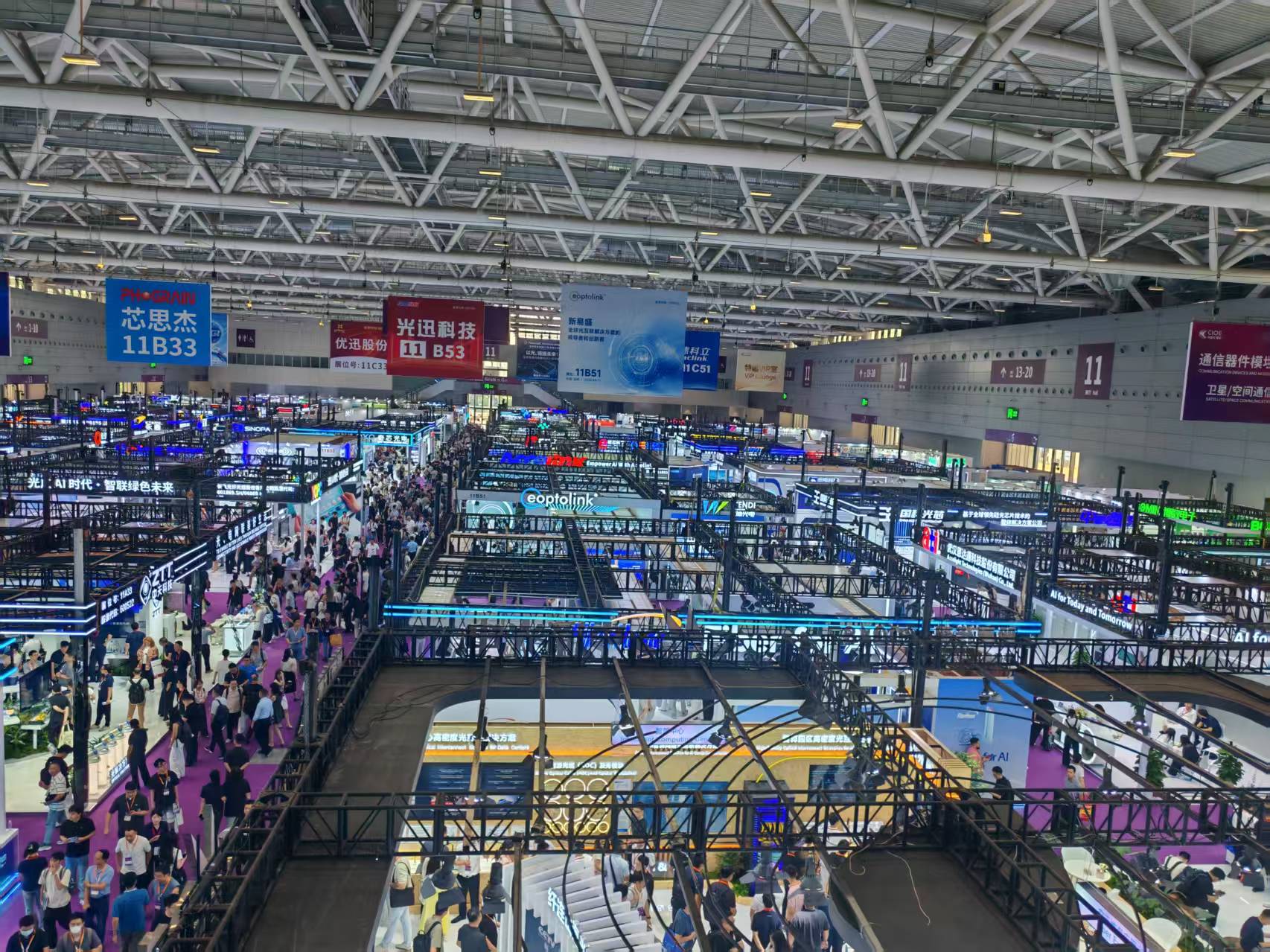
Overall, CIOE 2026 clearly demonstrated several key trends in the optical communication industry driven by AI computing power: accelerated speed iteration (1.6T has become mainstream, 3.2T/6.4T accelerating validation), packaging architecture transformation (NPO/CPO moving from pre-research to mass-production validation), in-depth domestic substitution (comprehensive breakthroughs from optical chips to high-end test instruments and manufacturing equipment), and innovation in basic fiber materials (commercialization of hollow-core fiber, explosive demand for polarization-maintaining fiber). The entire industry chain is building a higher-speed, lower-power, more autonomous and controllable optical interconnection foundation for the upcoming larger-scale AI clusters.
Shenzhen Fholink Technology Co., Ltd.'s current product line covers DCI equipment, OLP optical line protection, wavelength division multiplexers (CWDM/DWDM), optical modules, and optical repeaters, positioning itself at the level of optical transmission equipment integration and solution delivery. As a small and medium-sized equipment vendor with limited resources, Fholink cannot compete head-on with leading manufacturers in optical chip or optical engine design. The company's core strategy is to "do supporting components, do integration, do scenarios": within the technical framework defined by leading manufacturers, provide high-quality functional supporting equipment and solution integration services. New and existing customers are welcome to grow together with us. In the torrent of optical communication development, stand on the present and look to the future!!!


