


Semantic Communication — Networks Begin to "Transmit Meaning" Instead of "Transmitting Bits"
Semantic communication represents a paradigm shift from "accurately transmitting bits" to "effectively delivering meaning." It no longer pursues bit-perfect reproduction of the original data, but instead strives to enable the receiver to understand the sender's intent or task, transmitting only the core semantic information most relevant to the task.
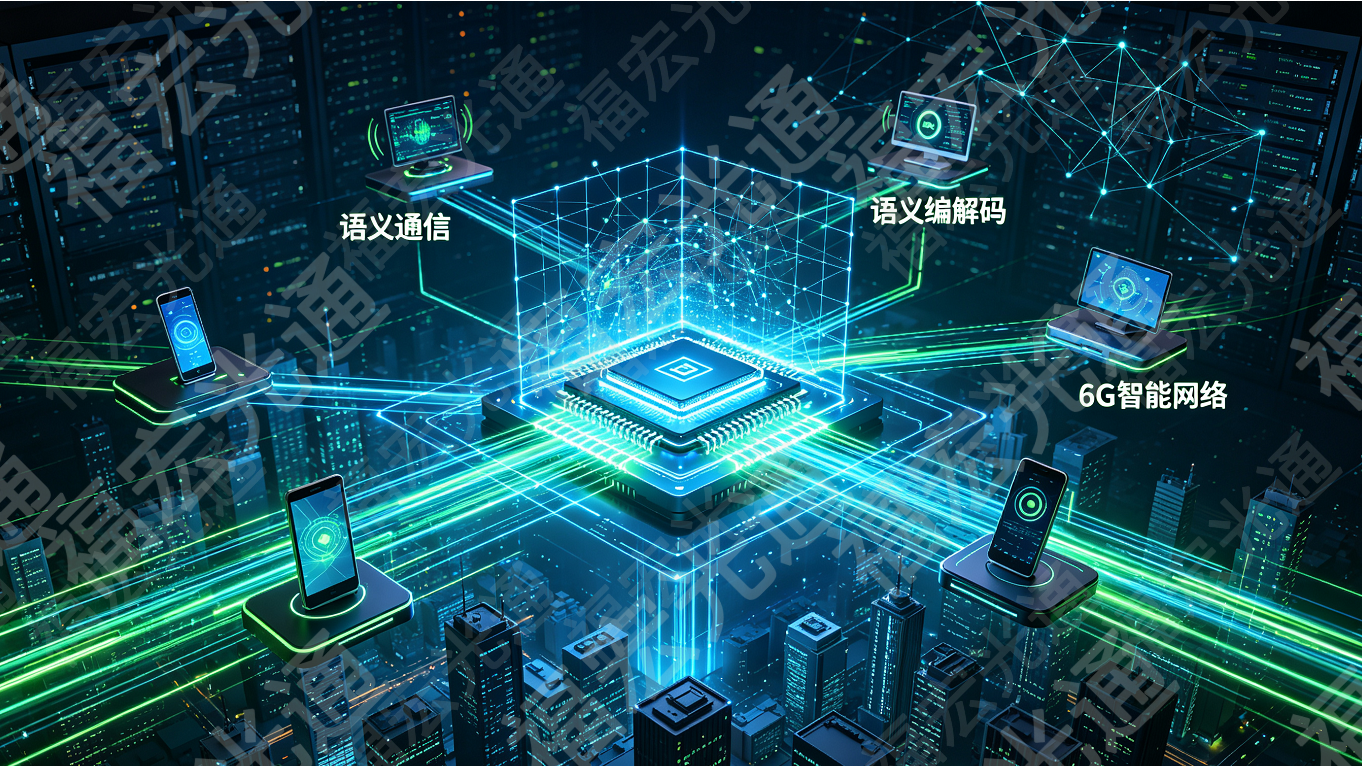
Fundamental Difference from Traditional Communication
Traditional communication is like a "precision photocopier": regardless of whether the content is critical or not, it transmits every bit indiscriminately, and its performance is measured by syntax-level metrics such as bit error rate and throughput. Semantic communication, by contrast, is like a "smart highlighter expert": it focuses on the meaning of information, the context, and usefulness for the task, and its core evaluation criteria shift to effectiveness-level metrics such as semantic similarity and task success rate.
Core Advantages: Why "Highlight the Key Points"?
1. Extreme Transmission Efficiency
By eliminating massive amounts of redundant data, semantic communication can reduce data transmission volume by more than 60%. With the assistance of generative AI, in some scenarios (such as video retrieval), communication overhead can even achieve an astonishing reduction of 99.98%, while task accuracy improves by 53%.
2. Strong Interference Resistance and Robustness
Under poor channels with weak signals or strong interference, traditional communication can be paralyzed by garbled data, whereas semantic communication can still accurately parse the core meaning even when the received data is ambiguous, greatly reducing the system's stringent requirements on signal-to-noise ratio.
3. "Task-Centric" Intelligence
The communication goal changes from "transmitting data" to "completing tasks." For example, in the Internet of Vehicles, vehicles do not need to exchange raw sensor data; they only need to transmit a semantic summary such as "there is an obstacle ahead, need to slow down," and the receiver can generate driving instructions accordingly.
Key Technical Pillars
Joint Source-Channel Coding (JSCC)
This breaks the traditional step-by-step model of "compress first, then add protection," integrating semantic extraction and anti-interference protection into a single design. While extracting the core meaning, the system simultaneously computes the optimal protection scheme, achieving both efficiency and reliability.
AI-Driven Semantic Codec
Deep learning models (such as autoencoders, GANs, and diffusion models) as well as large language models (LLMs) are the core engines for semantic extraction. LLMs can serve as "AI agents" at both the transmitting and receiving ends, extracting compact semantic embeddings from multimodal data and directly generating task-oriented content at the receiver.
Semantics-Aware Retransmission Mechanism
This breaks the convention of "retransmit on every error." Retransmission is triggered only when semantic integrity at the receiver is impaired, rather than correcting every bit error, thereby significantly improving transmission efficiency.
Typical Application Scenarios (Especially for 6G)
Semantic communication is regarded as a core enabling technology for 6G, with main applications concentrated in:
- Industrial Internet of Things (IIoT): In resource-constrained sensor networks, only semantic summaries of device status and alarms are transmitted, greatly reducing bandwidth and power consumption.
- Internet of Vehicles (V2X): Vehicles exchange semanticized road condition information, balancing low latency and privacy security.
- Metaverse and Immersive Interaction: User actions and scene descriptions are transmitted in lightweight semantic form, and the receiver regenerates high-quality virtual content in real time, rather than transmitting raw high-definition video streams.
- Low-Altitude Economy: Drone swarms condense sensing data into semantic summaries for backhaul, alleviating airspace communication congestion.
- Extreme Scenarios such as Deep-Sea Underwater Acoustic Communication: In environments with extremely poor channel conditions where traditional communication is almost unusable, semantic communication can still maintain basic information delivery.
Main Challenges and Future Directions
Despite broad prospects, semantic communication still faces multiple obstacles on the path to practical application:
- Lack of Standardization: This is the biggest challenge. There is currently no unified protocol, data format, or evaluation metric (how to quantify "semantics"), different systems cannot interoperate, and there is no ready-made "semantic QoS" resource allocation model.
- Computational Complexity: Semantic encoding and decoding rely on complex AI models, imposing a heavy computational burden in real-time applications. How to run them efficiently on resource-constrained edge devices is key to engineering deployment.
- Semantic Alignment and Heterogeneity: When the sender and receiver have different background knowledge or models, how to ensure consistent understanding of "meaning" is a fundamental problem that remains unsolved.
- Integration with Existing Systems: Future networks will inevitably require hybrid semantic-traditional communication modes. How to decide which data goes through semantic channels and which goes through traditional channels is a dynamic resource partitioning challenge.
- Privacy and Security: Semantic extraction itself may leak sensitive information, and attacks targeting semantics (such as tampering with intent) are also new security threats.
Summary
The essence of semantic communication is to enable communication networks to evolve from passive "data pipelines" into intelligent agents capable of understanding intent and focusing on tasks. Through AI-driven "highlighting of key points," it opens a new path for improving communication efficiency, robustness, and intelligence against the backdrop of approaching the Shannon limit in the 6G era. Currently, it is in a transition period from theory to localized trial commercial use (such as in specific vertical industries like the Industrial Internet of Things), and is expected to be gradually incorporated into the 6G standard framework within the next 5–10 years.
Shenzhen Fholink Technology Co., Ltd. does not develop semantic codecs, does not train AI models, and does not participate in building semantic knowledge bases. The "intelligence" part of semantic communication belongs to the domain of algorithms and chips. Fholink already has complete product coverage in its domains. The DCI6500/5800 series and OTS optical transmission platforms undertake cross-domain bearer of semantic streams between data centers; the full series of optical modules complete the conversion from electrical-domain semantic bit streams to optical-domain signals; EDFA optical amplifiers compensate for power loss on long-distance links so that semantic features are not drowned by noise before reaching the receiver; DCM dispersion compensation manages pulse broadening and preserves the temporal structure required for semantic decoding; polarization-maintaining devices, PBS/PBC provide precise polarization control in architectures that carry semantic features in the polarization dimension; and OLP line protection completes switching within milliseconds when a fiber is interrupted, ensuring that semantic streams are not interrupted by physical-layer failures.


- 2026-05-25
- 2026-05-25
- 2026-05-25
- 2026-05-25
- 2026-05-25
- 2026-05-25
- 2026-05-25
- 2026-05-25


